
There’s something almost magical about stepping into a backyard draped in the warm, amber glow of string lights. That soft shimmer turns an ordinary patio into a place where time slows down, conversations stretch late into the evening, and even a Tuesday night feels like a celebration. If you’ve been wondering exactly how to hang patio lights the right way—without tangling wires, dealing with sagging strands, or making costly mistakes—you’re in exactly the right place.
Hanging outdoor lights is one of the most rewarding and affordable home improvement projects you can tackle yourself. According to a 2023 survey by the American Lighting Association, outdoor lighting upgrades are among the top five most requested home improvements, with string lights and café-style fixtures leading the trend. Yet most guides skip past the planning phase and leave you frustrated mid-project.
This guide walks you through every step—from choosing the right lights and mapping your anchor points to the best techniques for every surface and structure in your yard. Whether you’re working with a pergola, a fence, a deck railing, or starting completely from scratch with no natural anchor points, there’s a method here that will work beautifully for your space.
What You Need Before You Start Hanging Patio String Lights
Before you ever climb a ladder or drill a single hole, a few minutes of planning will save you hours of frustration later. The most successful patio string lights ideas begin on paper, not on a rooftop.
Measure Your Space First
Grab a measuring tape and walk your entire patio perimeter. Measure the distances between every potential anchor point—walls, fence posts, pergola beams, trees, and deck railings. Note where your nearest outdoor electrical outlet is located, because this determines where your first plug end must begin.
Spacing hooks about 6 to 8 feet apart is a reliable standard, and sketching your layout before buying lights—whether in a zigzag, perimeter run, or radiating pattern from a central point—helps you calculate exactly how many feet of strand you need. Always buy 10–15% more than your measurements suggest, because lights must droop gently between anchor points rather than pull taut like a clothesline.
Choose the Right Type of String Lights
Not all string lights are built for the outdoors. Before installing outdoor string lights, always look for an IP (Ingress Protection) rating of IP44 or higher—this indicates the lights are protected against splashing water from any direction. IP65 rated lights can handle direct rain and are ideal for year-round outdoor use.
The average socket spacing on a patio light string is at least 12 inches, but spacing can range all the way from 12 inches to 3 feet wide—professional installations that span hundreds of feet typically use the wider spacing, while smaller café setups work best with tighter spacing.
Here are the most popular types of outdoor string lights for patios:
- Edison/Vintage bulb lights – Large, exposed filament bulbs with a warm 2200K–2700K glow; perfect for bistro and café aesthetics
- Globe string lights – Rounded bulbs give a clean, modern look and distribute light evenly
- Fairy lights – Tiny, delicate LEDs ideal for wrapping around railings or weaving through planters
- Solar string lights – No wiring required; ideal for areas without outlet access
- Café/Bistro lights – Slightly larger bulbs on heavy-duty, weatherproof cord; the gold standard for outdoor entertaining
Gather Your Tools and Supplies
Before you begin stringing outdoor lights, assemble everything you need:
- Measuring tape and pencil
- Power drill with appropriate drill bits
- Outdoor-rated screw-in eye hooks or cup hooks
- Guy wire or galvanized steel cable (for long spans)
- Zip ties or S-hooks
- Ladder
- Outdoor-rated extension cord (if needed)
- Wire staples or cable clips (for fence runs)


How to Hang Patio Lights on a Pergola
A pergola is arguably the perfect structure for hanging patio lights—the open beams and clean lines make stringing lights not only easy but visually stunning. This is where those dreamy, drooping café-style canopies come to life.
How to Hang String Lights on a Pergola: Step by Step
Step 1: Install eye hooks into the beams. Drill a small pilot hole slightly narrower than your screw-in eye hook to prevent the wood from splitting. Space hooks directly across from each other on parallel beams so your strands hang at a consistent height. Inserting hooks or eye screws into anchor points along the beams gives you a reliable foundation, and stringing a steel guide wire between them first keeps the lights from stretching and sagging over time.
Step 2: Run a guide wire. For any span longer than 8 feet, always run a galvanized steel cable or heavy-duty guy wire between your anchor hooks before attaching the lights. A guy wire acts as a support line, removing the tension that builds up on string lights over time—in some cases, you’ll thread the lights directly through the wire before hanging. This simple step dramatically extends the life of your bulbs and wire.
Step 3: Attach lights with zip ties or hang-loops. Secure the center of each string light wire to the eye hook, using the hang-loops built into the strand if your lights have them—if not, zip ties work perfectly. Let the strand droop naturally between hooks rather than pulling it taut; the slight curve is what creates that romantic, bistro-style aesthetic.
Step 4: Connect multiple strands and plug in. Most patio string lights are designed with a male plug on one end and a female socket on the other, allowing you to daisy-chain multiple strands. Start hanging your first strand with the male plug closest to your outlet, then connect each subsequent strand’s male end to the previous strand’s female end, continuing until all strings are in place.
How to String Lights on a Pergola in Different Patterns
The pattern you choose dramatically changes the atmosphere string lights on a patio create. Here are the most popular arrangements:
- Parallel rows – Strands run in straight lines from one beam to the other; clean, modern, and easy to install
- Crisscross canopy – Strands cross diagonally overhead, creating a full ceiling of light; dramatic and romantic
- Perimeter only – Lights run around the outer edge of the pergola frame; subtle and architectural
- Zigzag pattern – A single long strand weaves back and forth across the full width; maximizes coverage with minimum strands
How to Hang String Lights on a Fence
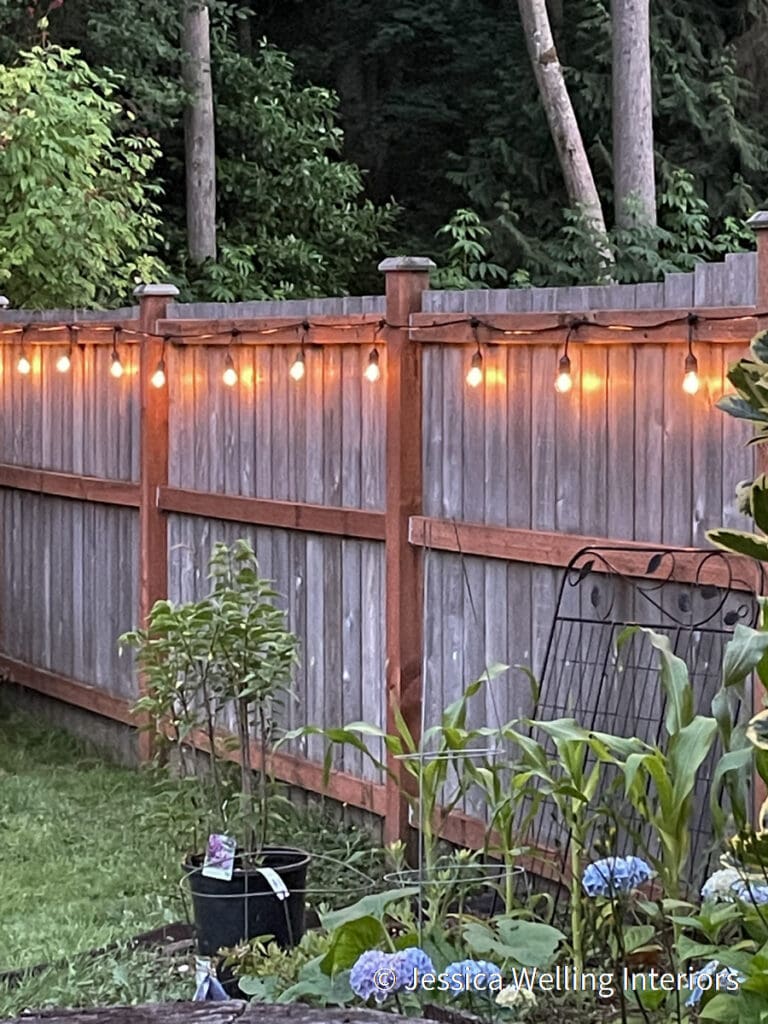
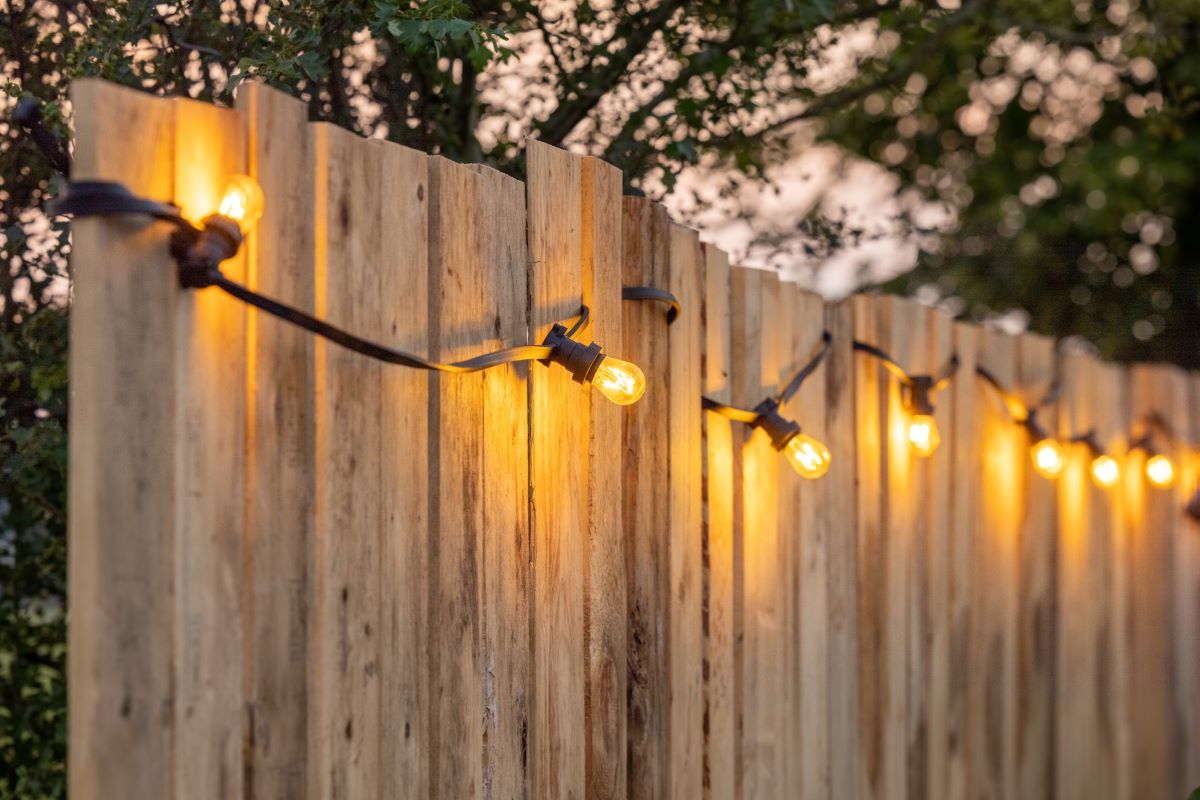
Hanging string lights on a fence is one of the easiest methods because fence posts give you perfectly spaced, sturdy anchor points every 6 to 8 feet—exactly the spacing you want.
The No-Drill Method for Fences
If you rent your home or simply don’t want to put holes in your fence, there are several effective no-drill alternatives for hanging outdoor string lights on a fence:
- Railing clips and wire clips – Snap-on clips specifically designed for fence rails hold the cord securely without any hardware
- Zip ties – Looped around fence posts and through the hang-loops of your light strand; invisible at night and easy to remove
- For deck railings, railing clips or zip ties spaced every 4 to 5 feet, looped around posts with waterproof connectors joining the strands, create a clean installation without any permanent modification.
The Drilled Method for Fences
For a more permanent and polished result when installing patio string lights along a fence line, drill a pilot hole into the center of each fence post and screw in a stainless-steel eye hook. Run your lights from hook to hook, allowing a gentle 4 to 6 inch droop between each post. This slight slack isn’t just aesthetic—it relieves tension on the wire and prevents breakage when the cord contracts in cold weather.
How to Hang Café Lights and Bistro Lights on a Patio
Café lights and bistro lights refer to the heavy-duty, commercial-grade string lights you see draped across restaurant patios and wine bars—and they’ve become one of the most sought-after patio string lights ideas for home use. The thick, rubberized cord and oversized vintage bulbs are both weatherproof and exceptionally durable.
How to Hang Café Lights on a Patio Without Existing Structures
One of the most common challenges is that not every patio has convenient walls or trees to anchor lights to. Here’s the best way to hang café lights when you’re working with an open space:
The DIY pole-in-planter method is a clever, no-digging solution. Choose metal conduit pipes or wooden posts as your poles, fill large planter pots with quick-setting concrete, insert the poles while the concrete is still wet, ensure they’re perfectly level, and allow the concrete to cure fully before use. Once cured, drill an eye hook or cup hook into the top of each pole, then string your lights between them.
For a decorative finish, leave enough room in the planter for a layer of gravel and some potting soil—you can plant seasonal flowers directly around the base of the pole for a polished, finished look.
Shepherd’s hooks offer another zero-drill solution. Place shepherd’s hooks firmly in the ground around the perimeter of your patio, then attach your lights to the hooks to create a soft canopy of light across the full space—the positioning can be adjusted any time without any permanent hardware.
How to Hang Bistro Lights on a Patio from a House Wall
When one side of your patio backs up to your home’s exterior wall, you have a solid anchor point that simplifies the whole project. Attaching outdoor string lights to a house requires the right fastener for your wall material:
- Wood siding – Screw-in outdoor hooks work directly into the wood; drill a pilot hole first
- Brick or masonry – Use a masonry drill bit and anchor plugs rated for outdoor use before inserting hooks
- Vinyl siding – Use vinyl siding hooks that slide up under the lip of each panel without drilling; no damage, fully removable
How to Hang String Lights on a Porch
A covered porch creates one of the most intimate and cozy settings for hanging patio string lights. The overhead ceiling makes the installation straightforward—but there are a few smart approaches depending on your ceiling type.
How to Hang Lights on a Porch Ceiling
For a covered porch or patio ceiling, you can arrange lights in a zigzag pattern across the ceiling, create a full canopy effect by crisscrossing the strands, or extend the lights from your covered space so they drape out across the open backyard to one or more anchor points on the far side.
For wood porch ceilings, screw-in cup hooks are your best friend. Space them 4 to 6 feet apart across the width of the ceiling and run your strands in parallel rows or diagonal crosses. For how to hang lights on a porch with a painted or stained ceiling, use adhesive-backed outdoor hooks rated for exterior use—they hold up to 5 lbs each and leave no damage when removed.
How to Hang Solar String Lights on a Porch or Deck
Solar string lights are an increasingly popular option, especially for areas without easy outlet access. They’ve improved dramatically in recent years—modern solar string lights with a high-efficiency panel can charge fully in 6 to 8 hours of direct sunlight and provide 8 to 12 hours of illumination. When installing solar string lights, place the solar panel where it receives the most direct sunlight during the day—often on a south-facing railing or fence top—then run the cord to wherever you want the lights to hang.
How to String Patio Lights Without Trees or Existing Structures
This is the challenge that stops most people in their tracks: a wide-open backyard with no fence, no pergola, no trees. The good news is there are excellent solutions for how to string patio lights without trees.
Using Freestanding Poles
The pole-in-planter method described above works beautifully for open spaces. For larger areas, space your DIY poles 8 to 12 feet apart and run your guide wire between them before draping the lights. Pre-made deck string light poles that attach directly to deck railings are also available and make the installation even simpler—no cement required for decked areas.
Using Umbrellas and Shade Sails
Umbrellas and shade sails serve a dual purpose—offering shade during the day and acting as a frame for hanging string lights at night. Wrap fairy lights around the ribs of a market umbrella or clip café-style lights along the edges of a shade sail for a low-effort, high-impact result.
Spanning Lights Across the Backyard
For large-span installations, a steel cable or galvanized wire strung between two poles or structures gives you a solid, non-sagging ridgeline. Using zip ties to secure each bulb’s hang-loop directly to the cable, then spreading the strand out evenly before tightening everything down, keeps the installation taut and weather-resistant—a process that goes remarkably quickly once the cable is in place.
Creative Patio String Light Ideas and Layout Patterns
Now for the fun part. Here are some inspiring patio string lights ideas that go beyond simply running lights from point A to point B.
Overhead Canopy Effect
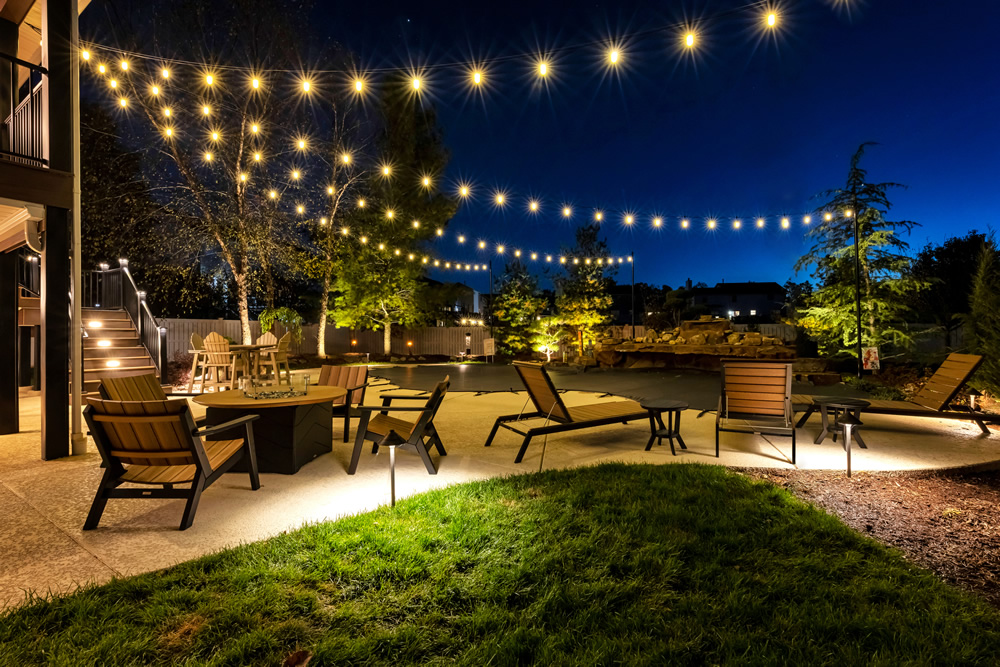
Crisscross multiple strands from all four corners of your patio inward toward a central point—like a circus tent. This creates a ceiling of warm light overhead and is one of the most breathtaking outdoor string lights setups possible. Use a heavy-duty hook or ceiling medallion at the center point to gather the strands together cleanly.
Perimeter Glow
Run hanging outdoor string lights along the perimeter of your fence, deck railing, or patio edge. This approach defines the outdoor room without overwhelming it with light—perfect for spaces where you also have lanterns, candles, or other light sources.
Under the Pergola Canopy
String lights under a pergola create a glowing, layered effect—especially beautiful when combined with climbing plants on the pergola posts. Run the lights between the inner crossbeams rather than the outer frame to keep everything centered and symmetrical.
Edison Lights on a Deck
Edison lights hung across a deck at approximately 9 to 10 feet of height create a comfortable, restaurant-quality atmosphere for outdoor dining. The warm 2200K color temperature mimics candlelight without the fire risk and pairs beautifully with natural wood decking and greenery.
Garden Path Lighting with Stakes
For garden borders and pathways, garden lights on individual stakes create a low, ground-level glow that’s both functional and beautiful. Combine staked path lights with overhead patio string lights for a layered lighting scheme that’s both practical and atmospheric.


Common Mistakes to Avoid When Hanging Outdoor Patio Lights
Even the most enthusiastic DIYers run into the same handful of problems. Knowing these in advance will save you time, money, and a few choice words on the ladder.
Buying Too Few Lights
The number one regret among people who tackle this project for the first time is not buying enough lights. Always measure twice, account for the gentle sag between anchor points, and add at least 10% to your total footage. Running out mid-installation means a second trip to the store, and lights from different batches can have subtle color temperature differences.
Not Using a Guide Wire on Long Spans
String lights are not structural cables. Over time—especially in heat—the cord relaxes and begins to sag. Any span longer than 8 feet should have a dedicated support cable between anchor points, with the light strand attached to that cable rather than bearing its own weight. This single precaution extends the life of your lights enormously.
Using Indoor-Rated Lights Outdoors
Indoor fairy lights are not waterproofed and will fail—or worse, become a fire hazard—when exposed to rain and moisture. Every product used in an outdoor installation should be explicitly rated for outdoor or all-weather use. Look for “outdoor rated,” “weatherproof,” or an IP44+ rating on the packaging.
Skipping the Pilot Hole
Driving a hook directly into wood without drilling a pilot hole first is a fast way to split a fence post or porch beam. Always drill a hole slightly smaller than the diameter of your hook’s screw thread before installing. The hook will hold far more securely, and the wood will remain intact.
Putting All Bulbs in Before Hanging
Remove all the bulbs from the light strings before hanging them to avoid breakage—a small step that saves a lot of replacement cost, especially with glass Edison-style bulbs.
Safety Tips for Installing String Lights Outdoors
Outdoor string lights installation is a beginner-friendly project, but there are a few non-negotiable safety practices to keep in mind.
- Never exceed the manufacturer’s wattage limit when daisy-chaining multiple strands together. Most standard string lights allow a maximum of 3 to 5 strands connected in series; exceeding this overloads the circuit
- Use a GFCI-protected outdoor outlet for all string light connections. GFCI (Ground Fault Circuit Interrupter) outlets cut power instantly if a fault is detected and are required by building codes for all outdoor electrical outlets in most regions
- Keep connections off the ground – All male-to-female strand connections should be suspended in the air or secured at height, never left on wet ground or grass
- Use outdoor-rated extension cords if your nearest outlet is too far from your installation—indoor extension cords are not weatherproofed and should never be used outside
FAQ: How to Hang Patio Lights
What is the best way to hang patio lights without drilling?
The best way to hang patio lights without drilling is to use railing clips, vinyl siding hooks, adhesive outdoor hooks, or zip ties around existing fence posts and railings. For open spaces with no anchor points, the DIY pole-in-planter method using quick-set concrete is a reliable no-drill solution.
How high should patio string lights be hung?
For comfortable headroom and the best visual effect, hang patio lights at a height of 8 to 10 feet. This keeps bulbs well above head level while still feeling intimate. For larger backyard spaces, 10 to 12 feet is more appropriate.
How do I hang string lights on a pergola without damaging the wood?
Install screw-in outdoor eye hooks into the beams using a pilot hole drilled slightly narrower than the hook’s shank. This is the most secure method and causes minimal damage. For a fully non-invasive option, adhesive-backed outdoor hooks rated for at least 5 lbs can be applied to smooth, painted wood surfaces.
Can I leave outdoor string lights up year-round?
Yes—as long as you use outdoor-rated, weatherproof lights with a rating of IP44 or higher and bulbs designed for outdoor use, patio string lights can remain in place year-round. LED string lights in particular are far more durable in cold and wet conditions than incandescent options.
How many string lights do I need for a 10×10 patio?
For a basic perimeter hang on a 10×10 patio, you need at least 40 to 45 feet of strand. For a crisscross canopy effect across the full space, budget 60 to 80 feet to account for multiple crossing strands and the sag between anchor points.
What hardware do I need to hang outdoor string lights from a house wall?
For wood siding: screw-in exterior cup hooks. For brick or stone: masonry anchors and hooks installed with a masonry drill bit. For vinyl siding: purpose-made vinyl siding hooks that slide under the siding panel without drilling. Always choose stainless steel or galvanized hardware for rust resistance.
How do I stop patio string lights from sagging?
Run a galvanized steel guide wire or cable between your anchor points first, then attach your light strand to the cable using zip ties or S-hooks. This offloads the mechanical stress from the light cord onto the cable, keeping everything taut and level regardless of temperature changes.
How do I connect multiple strands of patio string lights together?
Most patio string lights feature a male plug at one end and a female socket at the other end, designed for direct daisy-chaining. Simply plug the male end of the second strand into the female end of the first, continuing for as many strands as the manufacturer allows—typically no more than 3 to 5 strands on a single circuit.
Do I need a special outdoor extension cord for patio lights?
Yes. Always use an extension cord that is explicitly rated for outdoor use—it will be labeled “outdoor” or “exterior” on the packaging and features weatherproofed insulation. Never use a standard indoor extension cord outside, even temporarily.
Are solar string lights bright enough for a patio?
Modern solar string lights with high-efficiency panels and LED bulbs provide sufficient brightness for ambiance and casual outdoor entertaining. However, they are generally not bright enough for task lighting or large open spaces. For maximum brightness, hardwired or outlet-connected LED patio string lights remain the better choice for primary outdoor lighting.
Conclusion
How to hang patio lights is ultimately a project that rewards a little preparation with a lot of payoff. Once you’ve measured your space, chosen the right lights, identified your anchor points, and installed a proper support system, the actual hanging goes quickly—and the result is a transformed outdoor space that you’ll enjoy every single evening.
Whether you’re draping café lights across a pergola, stringing bistro lights along a fence, wiring a full overhead canopy in an open backyard, or simply clipping lights around a small apartment balcony, the fundamentals are the same: plan well, use outdoor-rated hardware, support your spans with guide wire, and let the lights sag naturally for that irresistible, restaurant-quality glow.
The warm light of a well-hung string of patio lights doesn’t just illuminate a space—it transforms it into somewhere you actually want to be. And after spending an evening under that golden canopy of your own making, you’ll wonder how you ever sat outside without them.