
Picture this: you finally found the bed frame of your dreams online, you click “buy,” and two weeks later it shows up at your door — except it barely fits your bedroom wall, or worse, your mattress slides around inside it like a marble in a shoebox. This happens more often than you’d think, and it almost always comes down to one overlooked detail: full size bed frame size. Before you spend another minute scrolling through furniture listings, it helps to actually understand what you’re working with, in inches, feet, and real-world terms.
A full bed size sits right in the middle of the mattress world — bigger than a twin, smaller than a queen — which makes it a favorite for teenagers’ rooms, guest bedrooms, and first apartments. But “full” doesn’t always mean what people assume it means, and the confusion around full size bed frame dimensions trips up even experienced shoppers.
In this guide, we’ll walk through everything from how wide is a full bed frame to how many feet is a full size bed frame, so you’re not left guessing when it’s time to measure your room or pick the right frame.
What Is a Full Sized Bed, Exactly?
A full sized bed — sometimes still called a “double bed” in older furniture catalogs — is a mattress and frame combination designed for one adult or two smaller adults. It predates the queen size as the standard “couple’s bed” of the mid-20th century, before homes (and people) started wanting more room to stretch out.
If you’ve ever wondered what is a full sized bed compared to a twin, the simplest answer is width. A full bed is noticeably wider than a twin but keeps the same length, which is why it suits taller sleepers who don’t need extra width but do need extra legroom.
Double Bed Measurements vs. Full Bed Measurements
Here’s something that confuses a lot of shoppers: double bed measurments and full bed measurements are the same thing. “Double” is simply the older, more traditional name. So if a listing says “double,” you can treat the dimension of full size bed as identical.
Full Size Bed Frame Dimensions: The Exact Numbers
Let’s get straight to what you came here for — the full size bed frame dimensions in black and white.
- Width: 54 inches (4 feet 6 inches)
- Length: 75 inches (6 feet 3 inches)
- Total sleeping surface: approximately 4,050 square inches
So when someone asks how many inches is a full size bed frame, the answer is 54 inches across and 75 inches long. Translating that into full size bed frame dimensions in feet, you’re looking at roughly 4.5 feet wide by 6.25 feet long.
These numbers represent the measurement of full size bed frame for the mattress itself, but keep in mind the actual frame — the wooden or metal structure holding the mattress — typically adds an extra 1 to 4 inches on each side, depending on the design and headboard style.
Width of a Full Size Bed Frame
If you’re specifically focused on width of full size bed frame, 54 inches is your number. To put that in perspective, that’s about the width of two and a half standard bar stools lined up side by side, or roughly the wingspan of an average adult with arms slightly tucked in.
People often ask what is the width of a full size bed frame when comparing it to a queen, which measures 60 inches wide. That 6-inch difference might not sound like much on paper, but it’s noticeable once you’re actually lying in the bed — especially for couples.
Full Bed Length
The full bed length of 75 inches matches the length of a queen and king mattress, which is good news for taller individuals. So even though a full size bed is narrower than a queen, it won’t leave your feet hanging off the edge unless you’re significantly above average height (generally over 6’2″).
How Does a Full Bed Look Like in a Room?
A common question from first-time furniture shoppers is how does a full bed look like once it’s actually set up in a bedroom, not just on a spec sheet. In practice, a full bed frame takes up a moderate footprint — comfortably fitting in bedrooms as small as 9 feet by 10 feet, while still leaving walking space around two or three sides.
If you’re picturing what does a full bed look like next to common furniture, imagine it occupying roughly the same width as a loveseat sofa, but considerably longer.
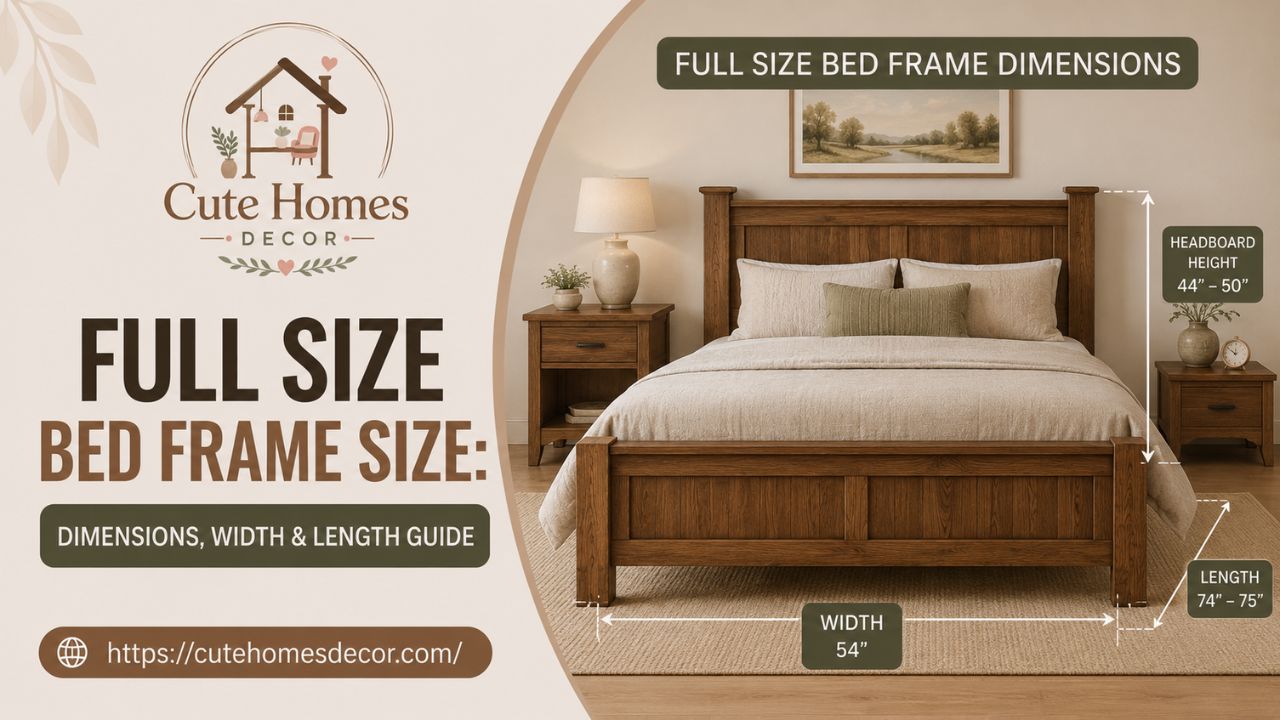
For visual reference, here’s what a full size frame typically looks like once styled in a bedroom setting:

A full size bed frame fits comfortably in small-to-medium bedrooms while still leaving walking space.
Full Size Bed Frame vs. Other Standard Sizes
Understanding full size bed frame size is much easier when you see it next to its siblings — twin, queen, and king.
| Bed Size | Width | Length |
|---|---|---|
| Twin | 38 inches | 75 inches |
| Full | 54 inches | 75 inches |
| Queen | 60 inches | 80 inches |
| King | 76 inches | 80 inches |
Full Size Mattress vs Twin
When comparing full size mattress vs twin, the length stays identical at 75 inches, but the full mattress offers 16 extra inches of width — enough for one adult to sleep comfortably without feeling boxed in, which is exactly why so many people upgrade from a twin to a full when transitioning out of a childhood bedroom.
What Size Bed Frame for a Full Mattress
If you already own a full mattress and you’re shopping for hardware, the question becomes what size bed frame for a full mattress you should buy. The answer is simple: look for frames explicitly labeled “full” or “full/double,” which are built to the standard 54-by-75-inch interior frame opening. Avoid frames labeled “full XL,” since that variant is designed for a 80-inch-long mattress instead of the standard 75 inches.
Short Full Size Bed Frame Options
Not every full bed needs a towering headboard. A short full size bed frame — typically a platform-style frame with a low profile of 12 to 16 inches off the ground — works well in rooms with low ceilings, slanted attic walls, or a more minimalist aesthetic. These frames keep the same 54-by-75-inch full bed size frame footprint but reduce visual bulk, which makes a small room feel more open.
Full Size Bed Frame with Headboard Dimensions
Adding a headboard changes the overall footprint, even though the mattress dimensions stay fixed. Full size bed frame with headboard dimensions generally add anywhere from 4 to 12 inches to the total length of the frame, depending on whether the headboard is a slim panel or an oversized upholstered design.
When measuring your wall space, always account for:
- The 75-inch mattress length
- An additional 4–12 inches for the headboard
- A few extra inches if a footboard is included
This is one of the most overlooked parts of mattress frame sizes shopping — people measure the mattress correctly but forget the headboard adds real depth to the room.

Headboards add extra inches beyond the standard 54×75 mattress footprint — measure your wall space accordingly.
Bed Frame Sizes in Centimeters
For shoppers outside the U.S. who are more familiar with metric measurements, here’s what size is a full bed in cm:
- Width: approximately 137 cm
- Length: approximately 191 cm
This conversion is especially useful if you’re comparing bed frame sizes across international retailers, since many European and Asian markets list furniture exclusively in centimeters.
Common Mistakes When Measuring for a Full Bed Frame
Even with the numbers in hand, plenty of buyers still run into problems. Here are a few of the most frequent ones, based on patterns seen across furniture return data and customer reviews.
- Forgetting the frame’s external dimensions. The 54×75 figure refers to the mattress, not the outer frame, which is often 2–4 inches larger on every side.
- Skipping doorway and stairwell measurements. A full bed frame’s longest single piece (usually the headboard or side rail) needs to physically travel through hallways and doorways during delivery.
- Assuming “double” and “full” differ. As covered earlier, these are interchangeable terms, so don’t second-guess a listing just because it uses the older name.
- Underestimating clearance space. Interior designers typically recommend at least 24–30 inches of walking space on at least one side of the bed for comfortable movement.
What Are the Measurements of a Full Size Bed Frame for Two People?
This is where expectations and reality often clash. While a full bed can technically fit two adults, the measurements for a full size bed frame mean each person gets roughly 27 inches of width — narrower than a standard twin bed per person. Sleep researchers and mattress industry surveys have repeatedly found that couples sleeping in a full-size bed report more disrupted sleep due to partner movement, compared to those in a queen or king. If you’re shopping as a couple, a full bed frame works best as a short-term or guest-room solution rather than a long-term shared sleeping space.
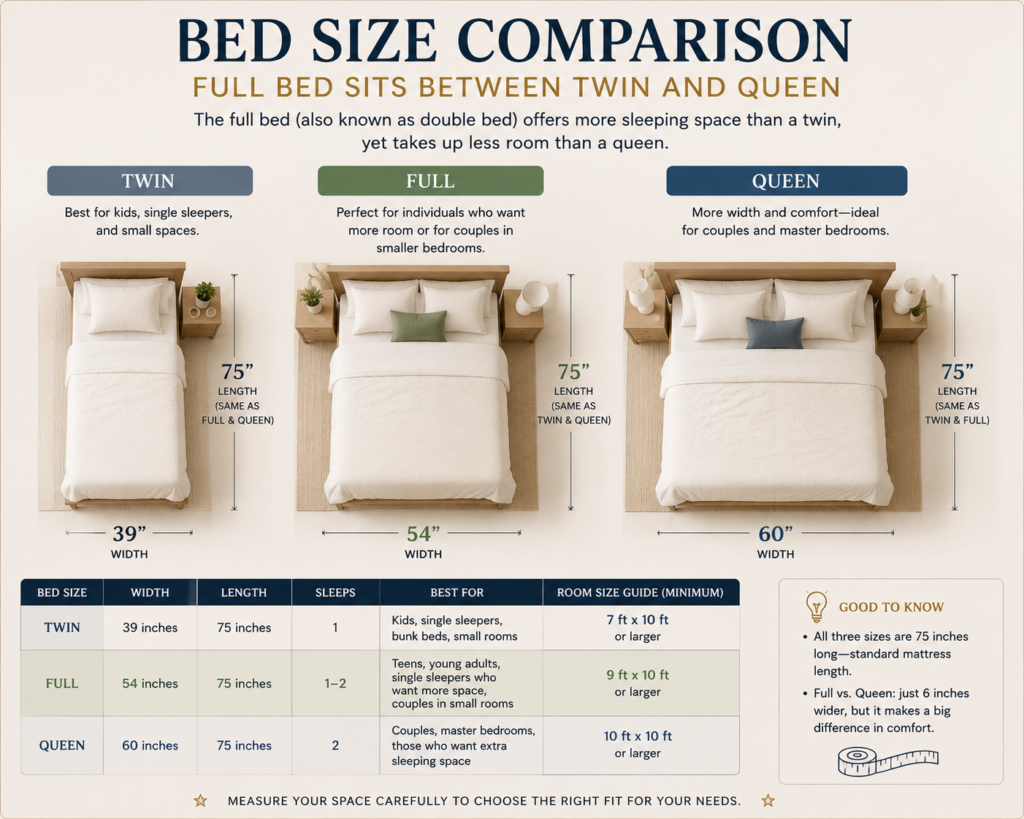
A full bed sits between twin and queen — 54 inches wide vs. 60 inches for queen, with identical 75-inch length to twin.
Choosing the Right Full Bed Frame Material
Once you’ve confirmed the full size frame dimensions fit your space, the next decision is material, which affects both durability and how “big” the frame feels visually.
Wood Frames
Solid wood frames tend to run slightly larger than their listed full bed dimensions because of thicker side rails and corner posts. They’re sturdy and long-lasting but can make a room feel more compact.
Metal Frames
Metal frames usually hug closer to the true full size bed dimensions, since the rails are thinner. They’re a popular choice for renters and smaller bedrooms because they maximize usable floor space.
Upholstered Frames
Upholstered frames add visual softness but, like headboard additions, often increase the full bed frame width by an inch or two due to padded side panels.
FAQs About Full Size Bed Frame Size
How wide is a full bed frame?
A full bed frame measures 54 inches wide on the inside (mattress-facing) dimension. The total outer width of the frame itself may be a few inches larger, depending on the rail thickness and design.
What are the dimensions of a full size bed frame?
The standard dimensions full size bed frame are 54 inches wide by 75 inches long, matching the dimensions of a full-size mattress.
How many feet is a full size bed?
A full size bed measures about 4.5 feet wide and 6.25 feet long, making it a manageable footprint for most standard bedroom sizes.
What is the difference between a full and a double bed?
There is no real difference — “full” and “double” describe the exact same mattress and frame dimensions. The term “double” is simply older and less commonly used today.
What size room do I need for a full bed?
Most designers recommend a minimum room size of 9 feet by 10 feet to comfortably fit a full bed frame along with basic walking space and a nightstand.
Is a full size bed big enough for two adults?
It can work for two smaller adults or for short-term use, but each person only gets about 27 inches of width, which is narrower than a typical twin bed, so many couples eventually upgrade to a queen.
What is the difference between full and queen bed frame size?
A queen frame is 6 inches wider (60 inches) and 5 inches longer (80 inches) than a full frame, giving noticeably more shoulder and legroom for couples.
Does a full size bed frame fit a full XL mattress?
No. A standard full frame is built for a 75-inch-long mattress, while a full XL mattress measures 80 inches long, so it requires a frame specifically labeled “full XL.”
What’s the difference between a short full size bed frame and a regular one?
A short full size bed frame keeps the same 54-by-75-inch sleeping surface but sits lower to the ground, usually under 16 inches in height, which suits low-ceiling rooms or a minimalist look.
Final Thoughts
At the end of the day, getting your full size bed frame size right comes down to a handful of numbers — 54 inches wide, 75 inches long, give or take a few extra inches for the frame itself, the headboard, and any decorative additions. Whether you’re furnishing a guest room, downsizing from a queen, or setting up a teenager’s first “grown-up” bedroom, knowing these measurements ahead of time saves you from the frustration of mismatched furniture and last-minute returns. Measure twice, double-check your doorways, and the rest of the process becomes refreshingly simple.