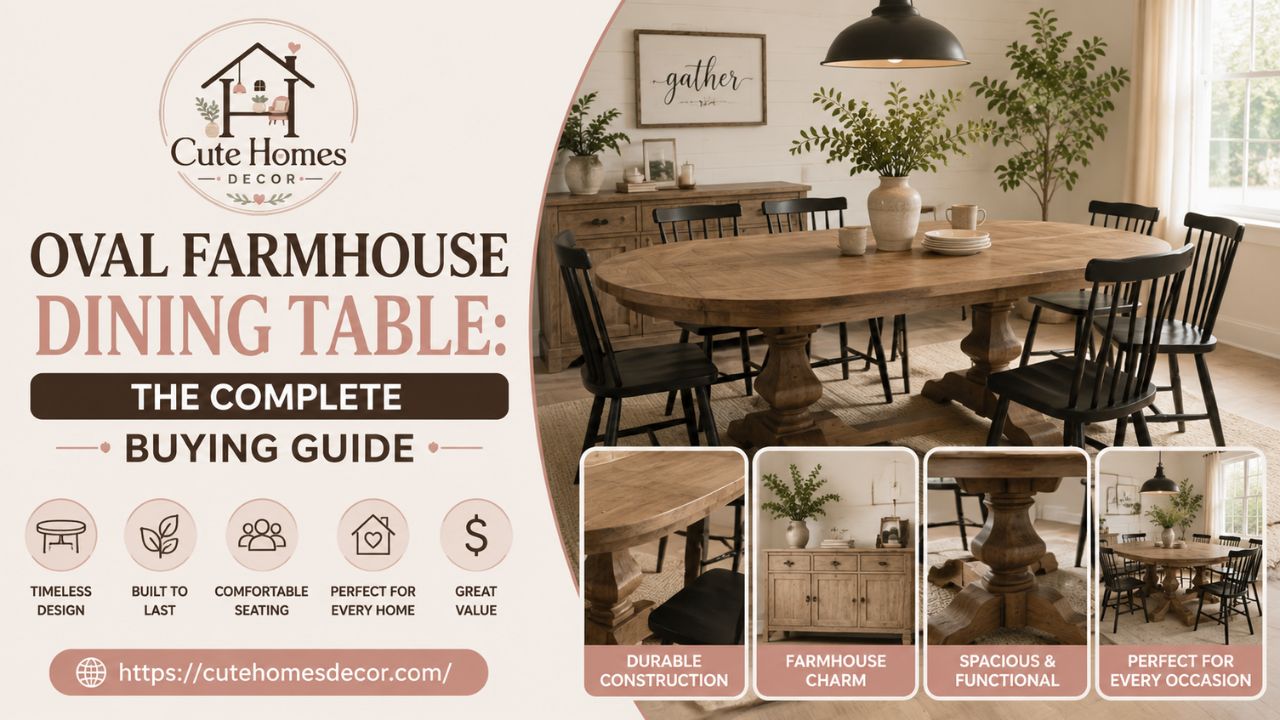

There’s a reason so many families end up gathered around the same piece of furniture for decades — birthdays, homework, Sunday dinners, the occasional puzzle marathon. If you’re shopping for that piece right now, chances are you’ve landed on the oval farmhouse dining table, and honestly, it’s an easy shape to fall for. It softens a room, forgives a little extra elbow room, and somehow manages to look both cozy and put-together at the same time.
But picking the right one isn’t as simple as scrolling through a furniture site and clicking “add to cart.” Between pedestal bases, wood finishes, size charts, and the endless debate of round versus oval versus rectangular, it’s easy to feel a little overwhelmed. This guide walks through everything worth knowing before you commit — from why an oval wood pedestal dining table tends to outperform four-legged designs, to how a small oval pedestal table can rescue an awkward kitchen nook.
By the end, you’ll know exactly what to look for, what to avoid, and which style actually fits your space and your life — not just your Pinterest board.
What Makes an Oval Farmhouse Dining Table Different
An oval farmhouse dining table blends two ideas that don’t always show up together: the soft, flowing lines of an oval tabletop, and the sturdy, lived-in character of farmhouse design. Farmhouse furniture traditionally leans on solid wood, visible grain, turned or trestle legs, and finishes that look a little weathered on purpose. When that aesthetic meets an oval shape, you get a table that feels warm and approachable rather than formal or boxy.
The Shape Advantage
Ovals solve a practical problem that rectangles and rounds each struggle with on their own. A round table looks great in a square room but wastes space in a narrow one. A rectangular table fits a narrow room perfectly but can feel harsh and corner-heavy in a smaller space. An oval borrows the best of both — it fits into a long, narrow dining area the way a rectangle does, but nobody’s hip is going to catch a sharp 90-degree corner while walking past.
There’s also a social dimension people don’t talk about enough. Oval tables tend to encourage conversation across the table rather than down a long line, which is part of why so many designers and researchers studying communal dining spaces point to curved-edge tables as better for group interaction in tighter rooms.
Farmhouse Style Elements
The farmhouse label usually means a few specific things:
- Solid or solid-look wood tops, often oak, pine, acacia, or mango wood
- Visible joinery and turned or trestle-style legs
- Matte finishes — think weathered gray, warm honey, or driftwood tones
- A slightly imperfect, handcrafted appearance rather than glossy uniformity
Put those elements on an oval top, and you’ve got a table that works in a cottage, a modern farmhouse, or even a transitional city apartment that wants a touch of warmth.
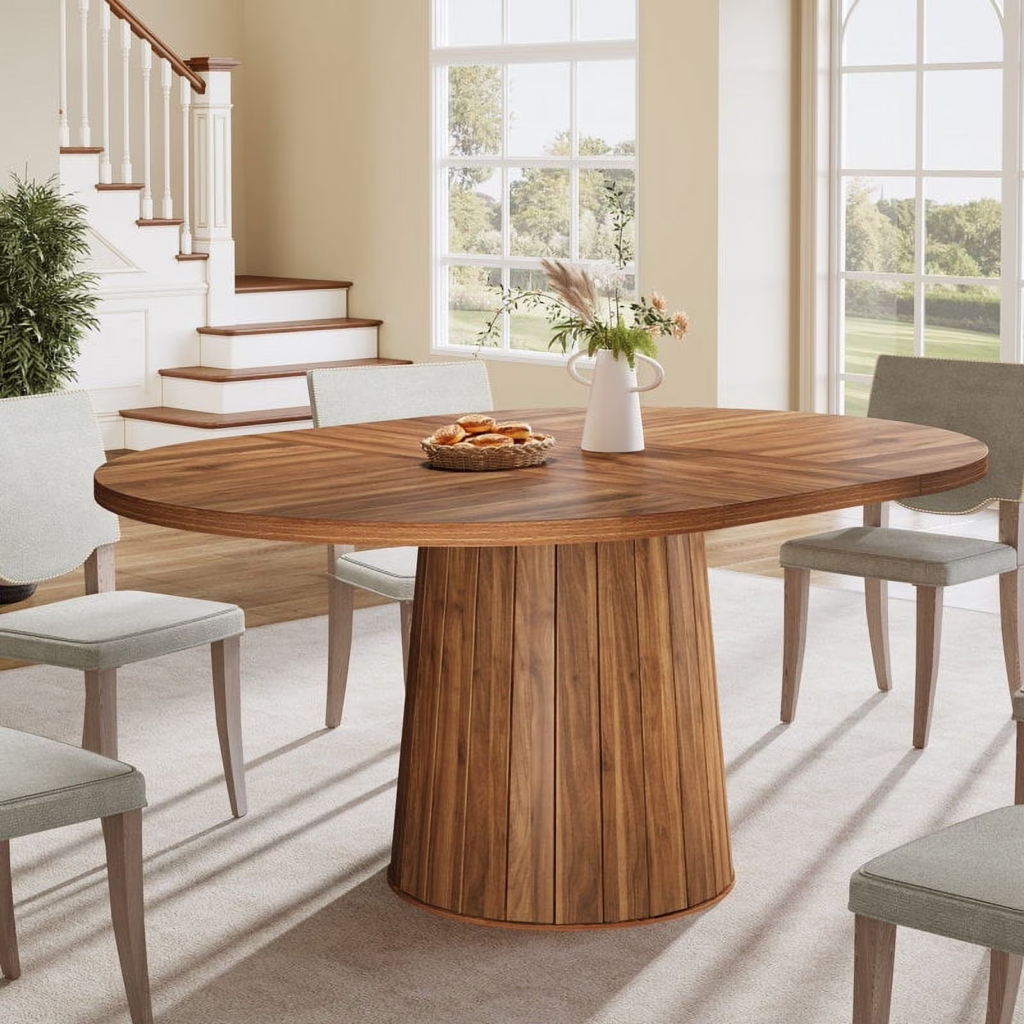
An oval farmhouse dining table with a solid wood pedestal base brings farmhouse warmth without sacrificing legroom.
Oval Wood Pedestal Dining Table: Why Pedestal Bases Work So Well
If you’ve spent any time comparing dining tables, you’ve probably noticed how often the oval wood pedestal dining table comes up as the recommended option over four-leg designs. That’s not a coincidence — the pedestal base solves a couple of real, everyday annoyances.
No More Bumped Knees
A traditional four-leg table places a leg near each corner, which sounds fine until you actually try to seat six or eight people. Legs end up directly in someone’s lap, and shifting a chair even slightly can mean bumping into wood. A pedestal base — usually a single center column or a trestle-style support — clears that space entirely. Everyone gets a clean, uninterrupted spot to tuck their chair in.
Stability and Weight Distribution
People sometimes assume a single-pedestal table must be less stable than one with four legs, but a well-built oval table with pedestal base actually spreads weight through a wide foot or cross-base at the bottom, distributing pressure evenly across the floor. The key is proportion: a pedestal base needs to be sized correctly for the tabletop above it, or the table can feel top-heavy. Reputable furniture makers account for this by widening the base foot as the tabletop grows longer, which is worth checking before you buy — measure the base footprint against the tabletop length as a quick sanity check.
Choosing Between an Oval Farm Table and a Rectangular One
This is the comparison most shoppers actually get stuck on. An oval farm table and a classic rectangular farm table share the same rustic DNA — solid wood, simple lines, sturdy construction — but they behave very differently in a room.
Here’s a simple way to think about it:
- Room shape matters more than room size. A long, narrow dining area often suits an oval better than a rectangle because there’s no sharp corner competing with a doorway or hallway traffic.
- Seating flexibility. Ovals can usually squeeze in one or two extra seats at the curved ends without anyone feeling cramped, since there’s no hard corner forcing an awkward angle.
- Visual weight. Rectangles read as more formal and structured. Ovals soften a room and tend to suit open-concept layouts where the dining space flows into a kitchen or living area.
- Family life. Homes with young kids or frequent movement around the table often do better with an oval — fewer corners means fewer bruised hips.
If your dining room is nearly square, a round or oval works beautifully. If it’s a long galley-style room, an oval farm table still fits the footprint while giving you softer, safer edges than a traditional rectangle.
Small Oval Pedestal Table Options for Cozy Spaces
Not everyone has a dedicated dining room, and that’s exactly where a small oval pedestal table earns its keep. Apartments, breakfast nooks, and open-concept condos benefit enormously from a compact oval design because it seats two to four people comfortably without dominating the room.
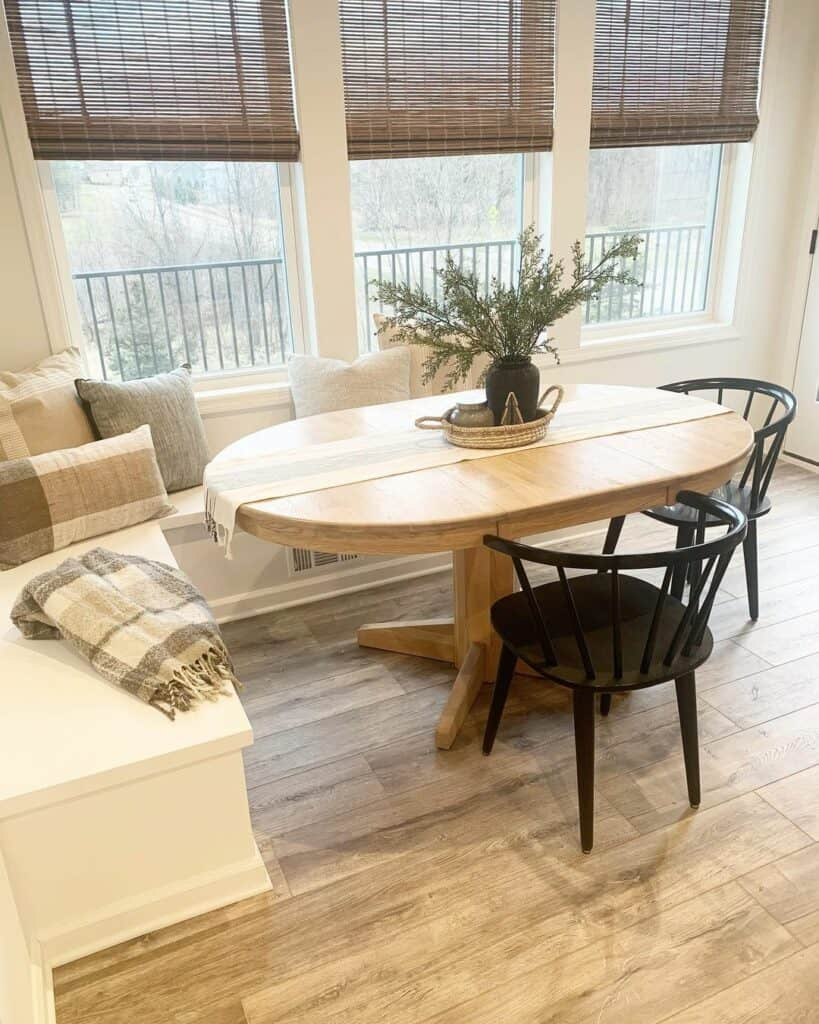
A small oval pedestal table fits comfortably into a breakfast nook without overwhelming the space.
A few things to look for in a smaller pedestal table:
- Extendable leaves. Many small oval tables include a hidden leaf that expands the tabletop for guests, then folds away for everyday use.
- Narrower pedestal bases. In a tight space, a slim column base keeps the table from feeling bulky.
- Lighter wood tones or two-tone finishes, which help a smaller table feel less heavy visually in a compact room.
A well-chosen small oval pedestal table can also double as a workspace, a spot for morning coffee, or an impromptu homework station — flexibility that a bulkier table just can’t offer.
Oval Table with Pedestal Base: Styles and Finishes
One of the best parts of shopping for an oval table with pedestal base today is how many finish options exist. Farmhouse style used to mean one look — distressed natural wood — but it’s expanded quite a bit.
Black Oval Pedestal Dining Table for a Modern Farmhouse Look
A black oval pedestal dining table has become one of the most requested styles in modern farmhouse and transitional homes, and it’s easy to see why. Black anchors a room, pairs effortlessly with both light and dark chairs, and photographs beautifully against white shiplap walls or neutral flooring — a combination that’s shown up repeatedly in home design coverage over the past several years as matte black furniture moved from accent pieces into full dining sets. It also tends to hide everyday wear better than a pale finish, which matters if the table sees daily family use rather than occasional formal dinners.
If you’re drawn to black but worried about it feeling too stark, look for finishes described as “matte black” or “black wash” rather than high-gloss lacquer — the softer sheen keeps the farmhouse character intact.
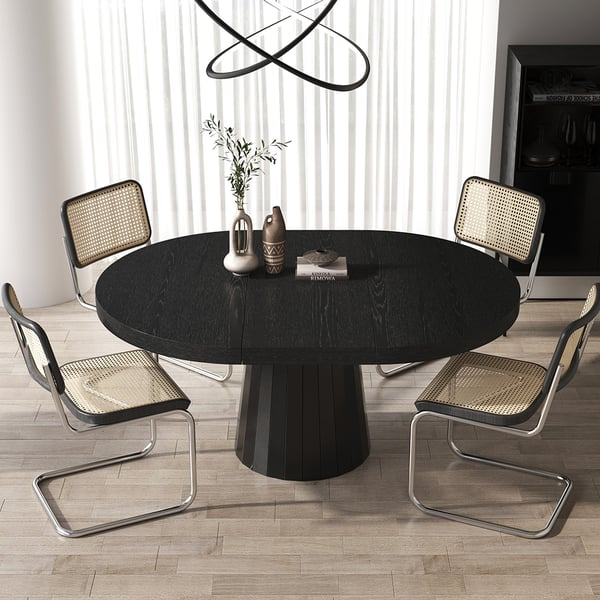
A black oval pedestal dining table anchors a modern farmhouse dining room while hiding everyday wear.
Natural Wood and Whitewashed Finishes
For a lighter, more traditional farmhouse feel, whitewashed oak, weathered gray, and honey-toned pine remain popular. These finishes let the wood grain show through, which is part of what makes farmhouse furniture feel handmade rather than mass-produced. Two-tone tables — a dark wood top with a whitewashed or painted pedestal base — have also become a popular middle ground between fully rustic and fully modern.
How to Measure Your Space Before Buying
This is the step people skip most often, and it’s the one that causes the most regret. Before falling in love with a specific table online, measure your actual room.
A workable rule of thumb:
- Leave at least 36 inches of clearance between the table edge and any wall or furniture, so chairs can slide out and people can walk behind seated guests.
- For an oval table, measure both the longest point (length) and the widest point (width) — ovals aren’t symmetrical the way rounds are, so both dimensions matter.
- Plan roughly 24 inches of table width per seated person, though oval curves often allow a little extra flexibility at the ends.
- If you’re considering an extendable oval farm table, measure the room with the leaf inserted, not just the base size — that’s the length you’ll need clearance for whenever guests come over.
Skipping this step is how people end up with a beautiful table that blocks a doorway or leaves no walking room on one side.
Materials and Durability
Solid wood remains the gold standard for a farmhouse-style table, particularly oak, acacia, and mango wood, all of which resist warping and hold up to daily use. Some manufacturers use engineered wood or veneer over MDF for the tabletop to keep costs down while still using solid wood for the pedestal base and legs — a reasonable compromise if budget is tight, as long as the veneer is genuine wood rather than a printed laminate.
When comparing options, a few durability questions are worth asking:
- Is the tabletop solid wood, veneer, or laminate?
- What’s the finish — a hand-rubbed oil, a polyurethane topcoat, or paint?
- Does the pedestal base use a cross-brace or steel reinforcement plate at the floor for extra stability?
- What’s the weight capacity, and has it been tested for regular use rather than just display?
A table built with these details in mind will typically outlast one chosen purely on appearance.
Care and Maintenance Tips
- Wipe spills quickly, especially on oil-finished wood, which is more porous than polyurethane-coated surfaces.
- Use coasters and placemats for hot dishes, since sudden temperature changes can stress a wood finish over time.
- Reapply furniture wax or oil once or twice a year on natural wood finishes to keep the surface from drying out.
- For a matte black finish, avoid abrasive cleaners — a soft cloth with mild soap and water is usually enough.
- Check pedestal base bolts periodically, since a well-used table can loosen slightly over months of daily wear.
Frequently Asked Questions
What is the standard size of an oval farmhouse dining table?
Most oval farmhouse dining tables range from about 60 to 84 inches long and 36 to 44 inches wide, comfortably seating four to eight people depending on the length. Extendable versions can grow to over 96 inches with a leaf inserted.
Is a pedestal base sturdier than four legs?
When properly engineered, yes. A well-designed pedestal base distributes weight through a wide foot or cross-base, and it also removes the wobble risk that comes from four independent legs needing to sit perfectly level on an uneven floor.
How many people can sit at an oval table with a pedestal base?
A typical oval table with a pedestal base seats six comfortably, with room for two more at the curved ends if needed. Smaller versions seat four, while extended designs with a leaf can seat eight to ten.
Does a black oval pedestal dining table work with a farmhouse style?
Yes. Matte black finishes have become a popular part of modern farmhouse design, pairing well with light wood flooring, shiplap walls, and mixed-material chairs for a look that feels current without losing that cozy farmhouse warmth.
What’s the difference between an oval farm table and a regular dining table?
An oval farm table typically emphasizes solid wood construction, visible grain, and simpler, sturdier joinery associated with traditional farmhouse furniture, while a “regular” dining table can span any style, including sleek modern or glass-top designs.
Is a small oval pedestal table a good fit for apartments?
Very much so. A small oval pedestal table takes up less visual and physical space than a rectangular table of similar seating capacity, and the absence of corner legs makes it easier to navigate in a tight kitchen or dining nook.
How do I keep a wood pedestal table from wobbling?
Check that the floor is level first, since uneven flooring is the most common cause of wobble. If the base itself is loose, tighten the connecting bolts where the pedestal meets the tabletop and the floor plate.
Can an oval table with pedestal base be extended with leaves?
Many can. Look specifically for a “butterfly leaf” or “self-storing leaf” design, which folds beneath the tabletop when not in use and expands the table’s length without needing to store an extra piece separately.
Final Thoughts
Choosing a dining table is one of those decisions that quietly shapes daily life more than people expect — it’s where meals happen, where kids do homework, where friends linger long after the food’s gone. An oval farmhouse dining table tends to earn its place in a home because it balances softness with sturdiness, and formality with warmth, in a way that few other shapes manage as gracefully.
Whether you land on a natural wood pedestal design, a compact table for a cozy nook, or a bold black finish that anchors the whole room, the right choice really comes down to your space, your household, and how you actually plan to use it. Measure carefully, ask a few honest questions about materials, and pick the table that feels less like a purchase and more like the place your family will actually want to sit.