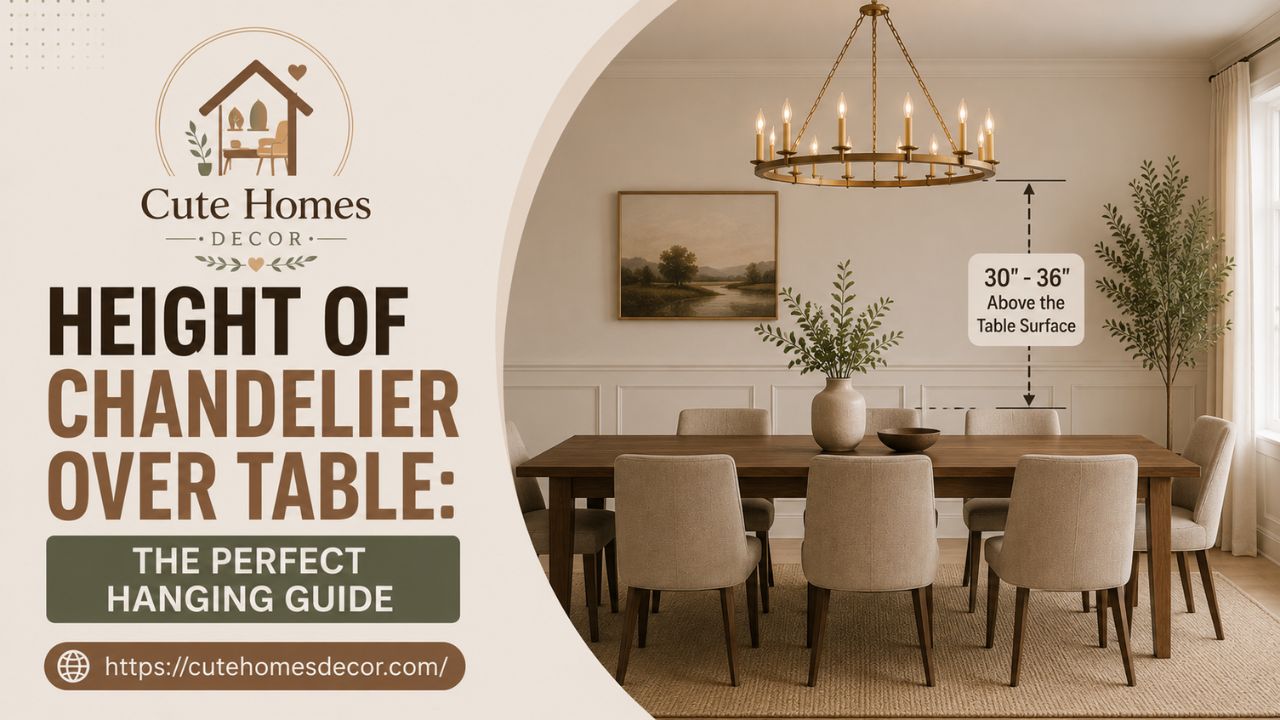

That chandelier above your dinner table isn’t just a light — it’s the jewel of the room. And getting its height even a few inches wrong can make an elegant fixture look awkward, overbearing, or completely out of place.
If you’ve ever stared up at a light dangling too close to your head, or squinted across a dining table trying to see your guest through a glare of bare bulbs, you already know the stakes. The height of chandelier over table is one of the most consequential — and most frequently botched — decisions in home design. Get it right and the room suddenly feels complete. Get it wrong and no amount of beautiful furniture or fresh paint can fix the vibe.
The good news is that there are clear, tested guidelines that designers and electricians have relied on for decades. Whether you’re renovating a formal dining room, freshening up a breakfast nook, or building a new home from scratch, this guide walks you through everything: the universal rule, the ceiling-height variables, how table size factors in, and all the common mistakes people make when they trust their gut instead of a measuring tape.
So let’s get into it — from the simplest starting formula to the nuanced adjustments that make the difference between “nice light” and “wow, this room is stunning.”
The Golden Rule for Height of Chandelier Over Table
Every reliable guide starts with the same foundational measurement, and for good reason — it works remarkably well across a wide range of room sizes and chandelier styles. The standard rule states that the bottom of your chandelier should hang 30 to 36 inches above the tabletop. This is widely accepted as the correct height for chandelier over dining table in rooms with standard 8-foot ceilings.
Why that specific range? It places the light source close enough to the table to provide warm, focused illumination for dining — the kind of light that makes food look appealing and faces look flattering — without creating the sensation of a fixture hovering threateningly over your guests’ heads. At 30 to 36 inches, a seated adult can still see clearly across the table without the chandelier interrupting their sightline. It’s a balance of function and aesthetics that’s been refined through generations of interior design practice.
Quick Rule of Thumb: For a standard 8-foot ceiling, aim for the bottom of your chandelier to sit 30–36 inches above the dining table surface. This is the universally accepted proper height for chandelier over dining table.
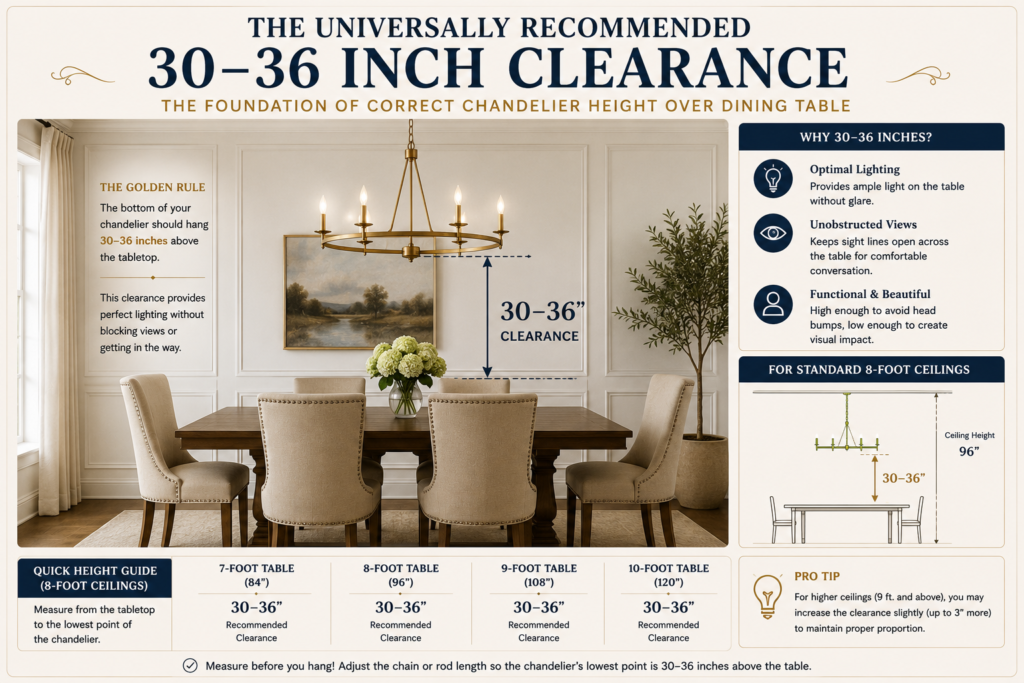
The universally recommended 30–36 inch clearance between the chandelier’s lowest point and the tabletop — the foundation of correct chandelier height over dining table for standard 8-foot ceilings.
How Ceiling Height Changes Everything
Here’s where things get more nuanced — and where most DIY decorators go wrong. The 30–36 inch rule is calibrated for the most common ceiling height in American homes: 8 feet. But if your ceilings are taller, that number needs to move up, or you’ll end up with a chandelier that looks like it’s floating in the middle of the room, disconnected from everything below it.
The standard adjustment is straightforward: for every foot of ceiling height above 8 feet, raise the chandelier by approximately 3 inches. So if you’re asking how high to hang chandelier over dining table in a room with 9-foot ceilings, your target is 33 to 39 inches above the table. For a 10-foot ceiling, you’re looking at 36 to 42 inches. For grand rooms with 12-foot ceilings, the chandelier height above dining table can reasonably go up to 48 inches.
Ceiling Height Reference Guide
| Ceiling Height | Bottom of Chandelier Above Table | Notes |
| 8 feet | 30 – 36 inches | Standard rule; most common in homes built after 1970 |
| 9 feet | 33 – 39 inches | Add ~3 inches per extra foot of ceiling |
| 10 feet | 36 – 42 inches | Allows for larger, grander fixtures |
| 11 feet | 39 – 45 inches | Use longer chain/rod; check electrical box reach |
| 12 feet | 42 – 48 inches | Consider a two-tier chandelier for visual balance |
One special case worth calling out: how high to hang chandelier over dining table 8-foot ceiling is actually one of the trickiest scenarios, because there’s very little margin for error. With only 8 feet of ceiling, your chandelier’s canopy will sit just 2 to 3 feet below the ceiling. If you choose a chandelier that’s too tall, you might find that you can’t achieve the proper chandelier height from table without the fixture looking cramped against the ceiling.
Pro tip for 8-foot ceilings: Choose a chandelier with a maximum overall height of about 20 to 24 inches to maintain both proper clearance from the ceiling and the correct distance between table and chandelier below.
What About Open-Plan and Vaulted Ceilings?
Vaulted ceilings present a unique challenge because the ceiling height varies across the room. The rule of thumb here is to measure the ceiling height directly above the dining table, not at the room’s peak, and apply the standard formula from that number. For very high vaulted ceilings — 14 feet and above — you may want to bring the chandelier down lower than the formula suggests, keeping the chandelier height from dining table in the 36 to 42 inch range. This grounds the fixture visually and ensures it actually illuminates the table rather than the airspace above your guests’ heads.
The Role of Table Size and Shape in Chandelier Height Over Dining Table
The height at which a chandelier hangs is inseparable from the relationship between the fixture and the table beneath it. A chandelier that’s perfectly positioned height-wise can still look wrong if its size doesn’t match the table’s footprint. Interior designers use a helpful shortcut: the diameter of your chandelier should be roughly half to two-thirds the width of your dining table.
So for a 42-inch wide rectangular table, a chandelier 21 to 28 inches in diameter is the sweet spot. Go too small and the fixture looks lost; go too big and it crowds the room. Understanding the chandelier to dining table ratio helps you realize that height and size work together — a larger chandelier may visually “work” slightly higher, while a smaller, more delicate fixture benefits from being hung a touch lower, toward the 30-inch mark of the range.
Round vs. Rectangular Tables
Round tables are forgiving — nearly any diameter chandelier centered above them creates a pleasing sense of symmetry. The dining table chandelier height rules apply equally: aim for that 30 to 36 inch clearance. Rectangular tables, however, often look best with elongated linear pendants or chandeliers that match the table’s long axis. For very long tables (over 84 inches), consider two pendant lights or a linear suspension fixture rather than a single round chandelier, and keep both fixtures at the same height above dining table.
Extending Table Considerations
If your dining table has leaves that extend it for larger gatherings, hang your chandelier to suit the table’s most commonly used size. When fully extended, the table may reach beyond the chandelier’s diameter — and that’s perfectly fine. The key is that the everyday version of your table should look well-matched and properly lit at the standard height for chandelier over table.
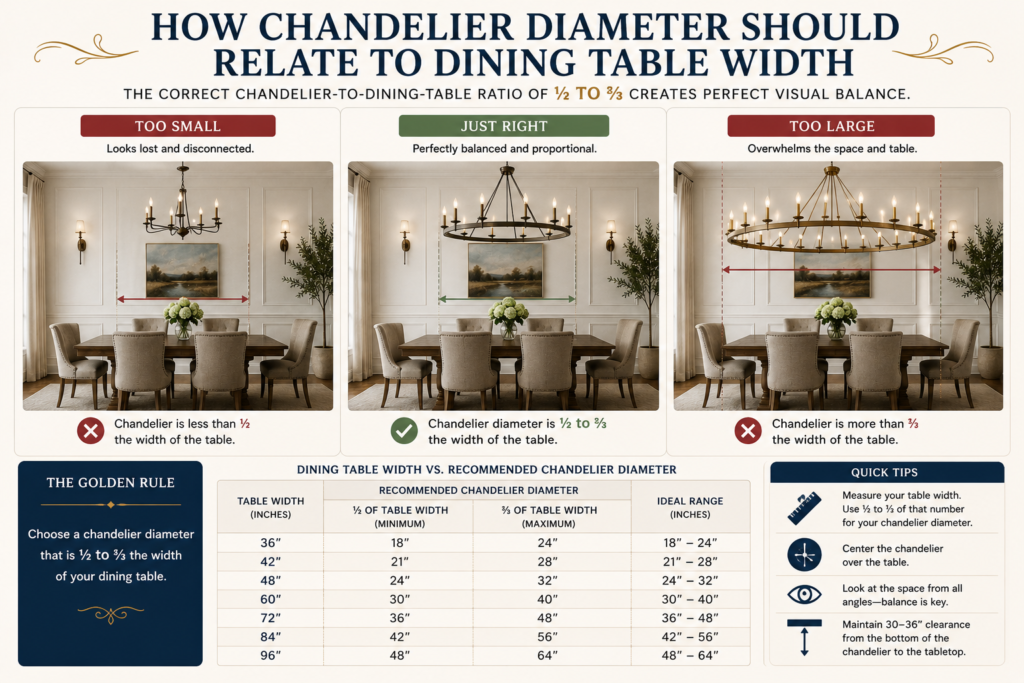
How chandelier diameter should relate to dining table width — too small looks lost, too large overwhelms, while the correct chandelier-to-dining-table ratio of ½ to ⅔ creates perfect visual balance.
How Low Should a Dining Room Chandelier Hang — and How Low Is Too Low?
If how low should a dining room chandelier hang is your main concern, the answer is clear: the lowest point of the fixture should never drop below 30 inches from the table surface in a dining room. At that level, the fixture is still out of eyeline for most seated adults and provides direct, intimate illumination without intruding on the space.
Go lower than 30 inches and you start creating real problems. People will duck when they push their chairs back. The chandelier becomes an obstacle rather than an accent. And from a safety standpoint, fixtures hanging below 7 feet from the floor in any room where people stand and walk should have smooth, rounded profiles — no dangling crystals at eye level.
The Floor Clearance Rule
Most interior designers and electricians also think about the dining room light height from floor, not just the distance from the table. The general rule is that the bottom of any light fixture in a room where people walk should be at least 7 feet from the floor. In a dining room, because people generally sit at the table and don’t walk beneath the chandelier, you can go somewhat lower — but not below about 6.5 feet from the floor in most residential settings.
Here’s a quick way to sanity-check your measurements: if your dining table is a standard height of 30 inches and the chandelier bottom is 33 inches above the table, the fixture’s lowest point is 63 inches (roughly 5 feet 3 inches) from the floor. That’s fine for a seated dining context, but might be a concern if your table is in a passthrough area where people frequently walk past.
How Low to Hang Dining Room Light in Open Kitchens
Kitchen tables and breakfast islands often share open-plan space with walkways and traffic. In these contexts, the how high should a light be above a kitchen table question needs to account for that foot traffic. Aim for the higher end of the range — 36 to 40 inches above the table — and also verify that your light fixture height above dining table leaves at least 7 feet of clearance from the floor. When in doubt, measure both from the table and from the floor before drilling any holes.
Room-by-Room Rules: Dining Room vs. Kitchen vs. Living Room
Dining Room Chandelier Height
The dining room is where the 30–36 inch rule lives most comfortably. The dining room chandelier height is specifically calibrated for a room dedicated to seated meals with relatively predictable ceiling heights and table placements. The standard dining room chandelier height of 30–36 inches above the table also assumes that the chandelier is centered over the table — which it always should be, both visually and electrically.
When someone asks about the proper height for dining room chandelier, the answer rarely changes: 30 to 36 inches. But the nuance lives in the specific style of chandelier. A crystal drop chandelier with pendants that hang below the main body may require you to measure from the lowest crystal, not the body of the fixture. A drum shade pendant is measured from the bottom of the shade. Always measure to the lowest physical point of the fixture.
Kitchen Table Chandelier Height
The rules for how high should a light be above a kitchen table are nearly identical to the dining room, but with one added consideration: kitchens tend to have busier, more casual atmospheres, and the light fixture often needs to perform a double duty — providing task lighting for cooking areas as well as ambient dining light. In these cases, a brighter, more focused pendant at 30–34 inches above the table is often preferable to a decorative chandelier at the higher end of the range.
Height of Chandelier in Living Room
Living rooms are a different situation altogether. The height of chandelier in living room is typically measured from the floor rather than from furniture, since living rooms don’t always have a single central table beneath the fixture. The standard rule for living room chandeliers is to hang the bottom of the fixture at least 7 feet from the floor — and ideally 8 feet or higher for grander spaces. If your chandelier hangs above a coffee table or an accent table, maintain a minimum clearance of 36 to 48 inches above that surface.
Common Mistakes When Hanging a Light Fixture Over Dining Table
1. Measuring to the Canopy, Not the Fixture Bottom
When electricians rough in wiring, they sometimes mark the box location based on the top of the chandelier or the canopy. But what matters to you and your guests is the distance from the table to the bottom of the chandelier. Always measure the chandelier height from table to the lowest hanging element, not to the canopy or ceiling mount.
2. Hanging Too High for Visual Impact
Overcompensating out of fear of hanging too low is just as problematic. A chandelier at 50 inches above the table in a room with 9-foot ceilings looks completely disconnected — it floats above the space without anchoring it. The distance between dining table and chandelier should create intimacy, not distance. Stick to the formula, and adjust only slightly based on specific visual preferences.
3. Ignoring the Fixture’s Vertical Proportions
A chandelier that is 36 inches tall will look dramatically different at the correct hanging height than a 12-inch flush-mount pendant would. Always account for the overall vertical dimension of your fixture when planning the chandelier height off table. If your fixture is tall and your ceilings are modest, you may need to choose a different style or use a shorter rod.
4. Forgetting to Account for Dimmer Switches
Always pair your chandelier with a dimmer. The correct height for chandelier over dining table creates the physical framework; the dimmer lets you dial in the mood. If you’re ever unsure which direction to lean, opt for the lower end of the 30–36 inch range with a dimmer, and you’ll have the best of both worlds.
- Always measure from the tabletop to the lowest point of the chandelier
- Adjust height by +3 inches for every foot of ceiling above 8 feet
- Keep the fixture centered over the table, not centered in the room
- Choose a chandelier diameter that is ½ to ⅓ the width of your table
- For low ceilings, choose a fixture 20–24 inches tall maximum
- Install a dimmer to maximize the chandelier’s flexibility at any height
Adjusting for Special Chandelier Styles and Fixtures
Crystal Chandeliers
Crystal chandeliers often have cascading strands or pendants that hang below the main body of the fixture. When measuring the chandelier height from table, always measure to the lowest crystal or hanging element. If those strands catch the light beautifully at table height, consider using the 30-inch minimum — the sparkle is part of the visual effect and works well close to the dining surface.
Drum Pendant Lights
Drum shades — cylindrical fabric or metal shades that hang over the table — tend to look best at 30 to 34 inches above the tabletop. Because they direct light downward in a focused cone, hanging them too high reduces their effectiveness as task lighting. A lower position (while staying above 30 inches) improves both light quality and visual proportion for this style.
Linear Suspension Fixtures
For rectangular tables, a linear fixture aligned with the table’s length creates a clean, modern aesthetic. The same height rules apply, but with one extra consideration: the length of the linear fixture should be about half to two-thirds the table’s length. The dining table light fixture height for linear pendants follows the standard 30–36 inch formula at both ends of the fixture.
Lantern-Style Fixtures
Lantern pendants — common in transitional and farmhouse designs — are usually hollow inside, so the visual “weight” is at the outer frame rather than a luminous center. These tend to look best at the higher end of the range, around 34 to 38 inches above the table, because their open form needs a bit more breathing room to feel grounded rather than cramped.
The Professional Installer’s Perspective on Dining Chandelier Height
When licensed electricians and professional interior designers approach a new installation, they think about the dining chandelier height in a systematic way that goes beyond just the distance from the table. Here’s how the pros approach it from start to finish.
First, they always confirm the location of the electrical junction box before committing to any measurements. The box position determines whether you need a long chain or rod, a swag kit, or even a new box installation to center the fixture properly over the table. Moving an electrical box is relatively inexpensive when factored into the total cost of an installation, and it makes every other measurement easier.
Second, pros always do a “dry hang” — temporarily suspending the chandelier at the proposed height before making final connections. They look at the fixture from every seat at the table, checking whether guests can see each other comfortably and whether the light creates harsh shadows or glare. The height from dining table to chandelier that looks right on paper can sometimes feel different in person, and the dry hang gives you the chance to adjust by an inch or two before the fixture is finalized.
Finally, professional installers always double-check the distance from chandelier to table against the fixture manufacturer’s recommendations. Some chandeliers — particularly those with downward-facing LED arrays — have minimum mounting heights to prevent glare. Always read the manufacturer’s installation sheet alongside the general guidelines in this article.
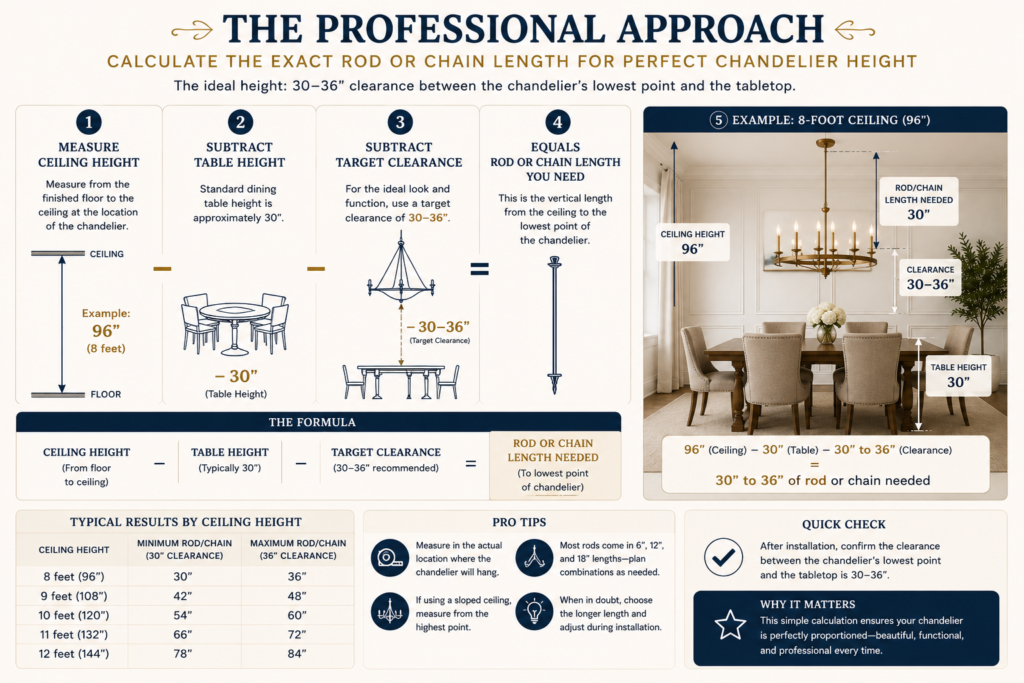
A step-by-step measurement approach used by professional installers — calculate ceiling height, subtract table height (30″) and target clearance (30–36″), and the result is the exact rod or chain length needed for the ideal dining chandelier height.
Frequently Asked Questions
How high should a chandelier be above a table?
The standard recommendation is that the bottom of the chandelier should hang 30 to 36 inches above the tabletop for rooms with 8-foot ceilings. For every additional foot of ceiling height, raise the fixture by approximately 3 inches. This range ensures adequate illumination, maintains sightlines, and keeps the chandelier visually connected to the table below. Understanding how high a chandelier should be above a table is the first step to a well-designed dining room.
What is the standard height of chandelier over dining table?
The standard height of chandelier over dining table is 30 to 36 inches from the bottom of the fixture to the tabletop surface in rooms with standard 8-foot ceilings. This is the measurement used by most interior designers, electricians, and chandelier manufacturers as the baseline for installation. Rooms with taller ceilings require an upward adjustment of 3 inches per additional foot of ceiling height.
How far above dining table should chandelier hang for a 9-foot ceiling?
For a 9-foot ceiling, how far above dining table should chandelier hang shifts to 33 to 39 inches above the tabletop. The additional foot of ceiling height above the 8-foot standard calls for a 3-inch upward adjustment to maintain the right proportions. This keeps the fixture from appearing too close to the ceiling while still providing focused illumination at the table.
How low should a chandelier hang over a table?
The minimum acceptable chandelier height over dining table is 30 inches above the tabletop. Going lower creates sight-line obstructions for seated guests, makes the fixture feel oppressive in the room, and can create safety issues with hanging elements at near-eye level. In dining rooms specifically — where guests remain seated — 30 inches is considered the lowest practical point, not a target.
What is the correct distance between table and chandelier?
The distance between table and chandelier — measured vertically from the tabletop to the lowest point of the fixture — should fall within 30 to 36 inches for standard ceiling heights, with adjustments upward for taller rooms. This distance has been validated through decades of interior design practice to optimize both light quality and visual comfort at the dining table.
How high should light be above dining table in a kitchen?
The answer to how high should light be above dining table in a kitchen context is essentially the same as a formal dining room: 30 to 36 inches above the tabletop. However, kitchen tables are often in high-traffic areas where people walk past the fixture, so erring toward the higher end of the range — and ensuring at least 7 feet of clearance from the floor — is advisable for safety and practicality.
What size chandelier should I use over a dining table?
For chandelier size relative to your dining table, use the ratio rule: chandelier diameter should be approximately half to two-thirds the width of your table. For a 48-inch wide table, a chandelier 24 to 32 inches in diameter works best. The chandelier to dining table ratio works hand-in-hand with height — a properly sized chandelier at the correct height creates the balanced, cohesive look that characterizes well-designed dining spaces.
How high should a dining room chandelier be from the floor?
While the primary measurement is from the table, checking the dining room light height from floor is a useful safety check. The bottom of the chandelier should generally be at least 6.5 to 7 feet above the floor in a seated dining area. This can be confirmed by adding the table height (typically 30 inches) to your chandelier clearance measurement.
Can I hang a chandelier off-center over a dining table?
A chandelier should always be centered over the dining table itself, not necessarily centered in the room. If your dining table is positioned off-center within the room, the chandelier should follow the table. This may require moving the electrical box, which is typically a minor job for a qualified electrician but well worth the effort for proper visual alignment and correct chandelier height above table proportions.
Does ceiling color or finish affect how high to hang the chandelier?
Ceiling color doesn’t change the recommended height for chandelier over dining table, but it does affect how the fixture looks at that height. Dark ceilings tend to visually lower the room, making a chandelier hung at 36 inches feel slightly closer and more intimate. Light or white ceilings make the room feel taller, and a fixture at 30 inches over the table can feel perfectly proportioned. When in doubt, adjust within the recommended range based on visual preference, always staying between 30 and 36 inches.
Conclusion
There’s real artistry in a perfectly hung chandelier — but the foundation of that artistry is practical math. The height of chandelier over table isn’t something you should guess or eyeball. It’s a measurement that flows from a simple formula: 30 to 36 inches above the tabletop for 8-foot ceilings, adjusted upward by 3 inches per additional foot of ceiling height, always measured to the lowest point of the fixture.
Beyond the numbers, remember that height works together with chandelier size, ceiling height, and table proportions to create a balanced, welcoming dining space. A chandelier that’s correctly sized and correctly positioned does something remarkable — it disappears into the room in the best possible way, becoming simply “the light” rather than an object you consciously notice and puzzle over every time you sit down for dinner.
Whether you’re installing your first chandelier in a new home or rethinking a fixture that has never quite looked right, go back to the formula. Measure carefully, do a dry hang before finalizing, and don’t forget to install a dimmer. Those three steps — and the measurements in this guide — will take you from uncertain to confident, and from “it’s fine” to genuinely proud of your dining room lighting.
Get the height right, and everything else about the room will follow.