
There is a reason people linger longer in certain dining rooms. Something about the soft curve of a wooden table, the warmth of a linen pendant light, the earthy smell of a natural material—it all communicates something that sleek, chrome-and-glass interiors simply cannot. The modern organic dining room is not a trend you see on a mood board and forget about. It is a way of living that is quietly taking over homes across the world, and for very good reason.
If you have been scrolling through interior design inspiration wondering why some spaces feel instantly calm and others just feel cold, the answer is almost always rooted in this aesthetic. The modern organic dining room blends the clean lines of contemporary design with textures, shapes, and materials that feel borrowed from nature—think raw-edge walnut tables, sculptural ceramic vessels, and chairs upholstered in undyed wool.
This guide is for anyone who wants to understand this design movement deeply, not just copy a Pinterest image. We will walk through the furniture, the materials, the layout principles, and the small styling decisions that separate a beautiful organic modern dining room from one that just looks like a showroom floor. Whether you are decorating from scratch or refreshing an existing space, you will find something useful here.
Let’s start at the heart of it all—the table itself.
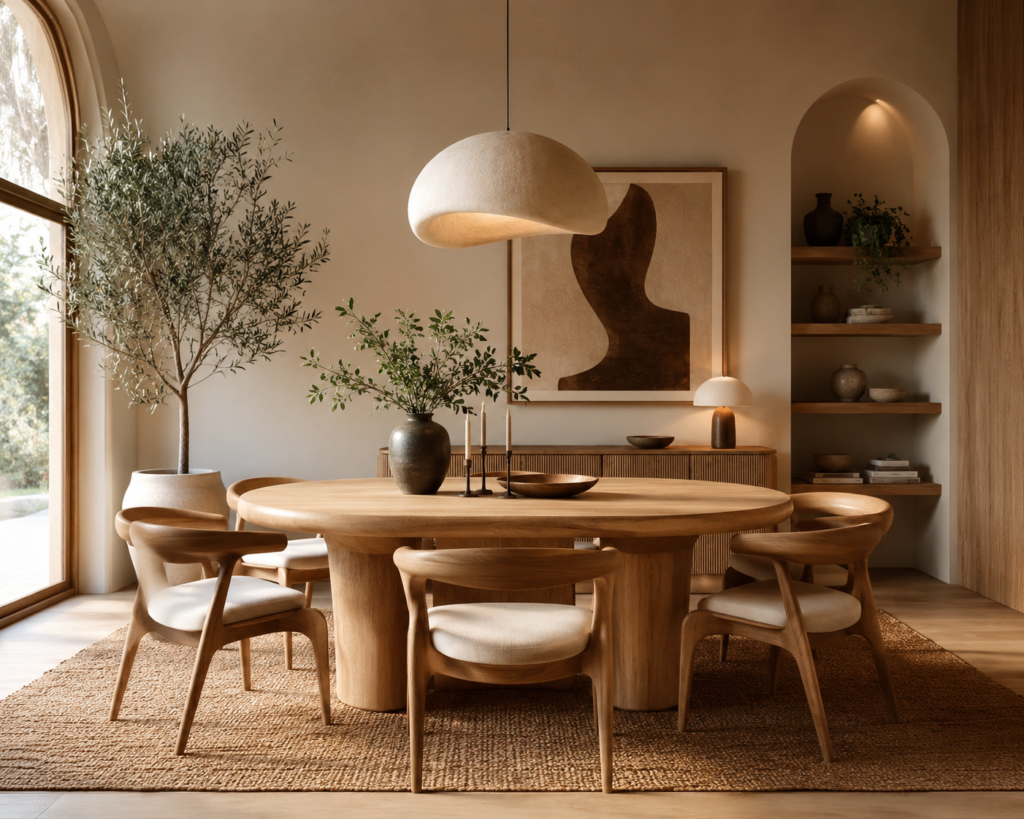
A well-designed modern organic dining room blends natural wood, warm tones, and sculptural forms to create an inviting, grounded atmosphere.
What Is the Modern Organic Dining Room Aesthetic, Really?
Before you start shopping for furniture, it helps to understand what actually defines this look—and what it is not. The organic modern aesthetic is not rustic. It is not farmhouse. It is not minimalist in the cold, sterile Scandinavian sense either. Instead, it sits at the intersection of three ideas: simplicity, nature, and intention.
Architecturally, rooms that work well with this style often have clean, uncluttered bones—plaster walls, concrete floors, or wide-plank hardwood. But what gives these rooms warmth and personality is everything layered on top: organic tables with curved or irregular silhouettes, furniture in muted earthy tones, and a deliberate absence of anything that feels mass-produced or artificial.
The Role of Biophilic Design
Biophilic design is a term architects and interior designers use to describe the intentional inclusion of natural elements in built spaces. Research from the Human Spaces Global Report found that people who work and live in environments that include natural elements report 15% higher levels of wellbeing and 6% higher productivity. When you translate that into a dining space, the argument becomes clear: a room designed with natural materials, organic shapes, and references to the outside world simply feels better to be in.
An organic dining table is not just a furniture piece—it is an anchor for this biophilic intention. Its shape, grain, and texture do the same psychological work that a window view or a houseplant does. It reminds the people sitting around it that they are part of something larger than the walls of a room.
How It Differs from Other Modern Styles
People sometimes confuse organic modernism with mid-century modern or Japandi. Here is a quick way to distinguish them:
- Mid-century modern is about geometry and retrofuturism—tapered legs, pops of mustard and avocado, and a nostalgic nod to the 1950s–70s.
- Japandi blends Japanese wabi-sabi with Scandinavian minimalism. It is quieter, more restrained, and almost monochromatic.
- Organic modernism is warmer than both. It celebrates imperfection in materials, irregular forms, and a visual conversation between the crafted and the natural.
A dining table organic modern lovers are drawn to will often feature a live edge, a subtly undulating surface, or legs that taper and curve rather than run at perfect right angles. That is the tell.
Choosing the Right Organic Modern Dining Table
The table is the gravitational center of any dining room. Everything else—the chairs, the rug, the lighting, the art on the wall—orbits it. Getting the table right is not about finding the most expensive piece. It is about understanding shape, scale, material, and finish and making choices that are right for your specific space.
Shape: Why the Curve Changes Everything
There is a compelling reason the organic shape dining table has become the single most searched furniture silhouette in contemporary interior design. Straight-edged rectangular tables, while practical, can feel formal and even confrontational—they visually segment the room and create a hierarchy around who sits where. An organic shaped dining table, by contrast, invites people in. Its softened perimeter makes conversation flow more naturally, and it reduces the visual weight in a room dramatically.
An organic shape table does not have to be radically sculptural. It can be as subtle as a rectangle with gently rounded corners, or as dramatic as a complete free-form silhouette that looks like it was shaped by water over centuries. The choice depends on the scale of your room and how bold you want the statement to be.
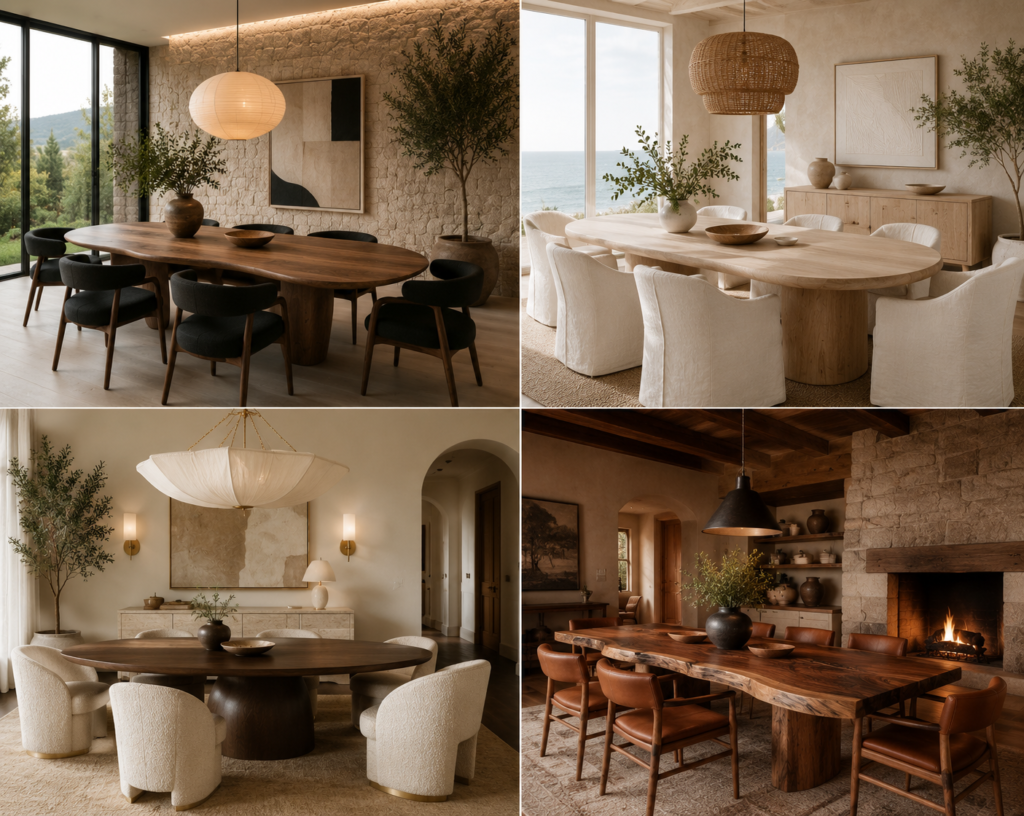
An organic shaped dining table in solid walnut creates a visual anchor that feels natural rather than imposed—its curves invite connection rather than formality.
Material: The Wood Conversation
Not all wood is created equal in this aesthetic. The material choices in an organic modern dining table carry a great deal of visual meaning. Here are the materials that resonate most authentically:
- Solid walnut — Rich, dark chocolate tones with a fine grain. Walnut is the most popular choice for a modern organic dining table because it has warmth without looking rustic.
- White oak — Lighter and more neutral than walnut, white oak suits spaces where the palette leans toward warm whites and greige.
- Live edge slabs — Single slabs cut from a full tree trunk, preserving the natural edge. A live edge organic dinning table is the most dramatic expression of this aesthetic—no two are alike.
- Travertine and stone — For those who want something cooler in temperature, a travertine-top organic modern kitchen table has an almost sculptural quality that reads as timeless rather than trendy.
Scale: Getting the Proportions Right
One of the most common mistakes people make is choosing a table that is too small for the room. A dining table should allow roughly 36 inches of clearance on all sides for comfortable movement. For seating, allow 24 inches of table length per person—so a table seating six should be at least 72 inches long.
For an organic modernism dining table with a curved or irregular shape, measuring becomes slightly more nuanced. Pay attention to the widest and narrowest points. The narrowest point still needs to allow for plates, glasses, and a centerpiece without feeling cramped.
Leg Design: Where the Character Lives
The legs of a modern organic table are where you can make or break the overall silhouette. The most common options in organic modern design include:
- Sculptural pedestal bases — A single central column, often in curved or flared form, creates a dramatic look and frees up legroom for guests.
- Trestle legs — A pair of A-frame or arch legs that give the table an artisanal, crafted quality.
- Tapered natural legs — Simple, slightly tapered wooden legs that echo the shape of a tree trunk. The most understated choice.
ORGANIC MODERN DINING ROOM — DESIGN AT A GLANCE
| IDEAL TABLE SHAPE Curved, oval, or organic free-form silhouette | BEST WOOD SPECIES Walnut, white oak, ash, live edge slab |
| SEATING ALLOWANCE 24″ per person / 36″ floor clearance all sides | COLOR PALETTE Warm whites, greige, terracotta, sage, walnut |
| LIGHTING CHOICE Rattan or linen pendants hung 30–34″ above table | ACCENT MATERIALS Linen, boucle, ceramic, travertine, jute |
| KEY AVOID High gloss finishes, chrome, stark white walls | SIDE TABLE STYLE Organic side table in stone, wood, or curved metal |
Building Your Modern Organic Dining Room Set
Once you have the table sorted, the next major decision is your organic modern dining set—the pairing of table and chairs. This is where many people stumble. They fall in love with a table and then pick chairs that are either too visually heavy, too spindly, or simply wrong in tone for the overall aesthetic.
Chair Materials That Work
In an organic modern dining room set, the chairs do not need to match the table exactly. In fact, a degree of contrast creates the kind of visual interest that makes a room feel curated rather than catalogued. Here are the chair materials that sing in this context:
- Boucle upholstery — Textured, loopy, and extraordinarily tactile. Boucle in cream or warm ivory is perhaps the single most popular chair choice in organic modern dining rooms right now.
- Saddle leather — A slightly more masculine, aged choice that adds depth and an editorial quality.
- Rattan and cane — If you want to stay entirely in natural materials, a rattan-back chair brings a beautiful handcrafted quality.
- Wooden seat chairs — Simple solid wood chairs in the same species as the table. Add a flat cushion in linen for comfort.
Mixing Chair Styles Intentionally
One approach that works particularly well is mixing chair styles—for example, using upholstered chairs at the heads of the table and armless wooden chairs along the sides. This creates visual rhythm without chaos, allowing the organic modern dining room table to remain the star of the show.
The key rule when mixing: keep the palette consistent. All chairs in the same tonal family. Vary the texture and shape, but hold the color story together.
The Modern Organic Kitchen Table: Extending the Aesthetic Into Your Kitchen
Open-plan living has made the distinction between dining room and kitchen increasingly blurred. In many modern homes, the dining table is actually within the kitchen zone—which means the principles of organic modern design need to carry through both spaces.
A modern organic kitchen table has slightly different demands than a dedicated dining room table. It may need to handle more daily wear—homework, morning coffee, casual snacking—so the material finish matters. An oiled walnut surface is far more forgiving than a waxed one; it can be touched up with a spot-oil application and looks better with age. A travertine-top organic modern kitchen table will develop a gentle patina over time—which, in the context of this aesthetic, is not a flaw but a feature.
Island vs. Table: Which Works Better?
In kitchens where space is limited, a large kitchen island often replaces the dining table. If that island is designed with an organic edge—a gently curved quartz countertop, or an irregular stone surface—it can function as a modern organic table while also serving all the practical demands of kitchen life.
However, if your layout permits both an island and a separate dining area, separating the two creates a much better dining experience. Meals feel more deliberate when they happen at a table that exists purely for that purpose.
Styling Details That Complete the Modern Organic Dining Room
The table and chairs are foundational, but the styling details are what make a room feel alive. Here is where the true craft of organic modern interior design lives.
Lighting: The Element Everyone Gets Wrong
Lighting over a dining table has two jobs: it needs to be functional enough to illuminate dinner, and atmospheric enough to create an evening mood. In organic modern spaces, the go-to choices are pendant lights made from rattan, woven fiber, ceramic, or handblown glass. These materials diffuse light rather than blasting it downward, giving the room that golden, warm quality you see in beautifully photographed dining spaces.
The height matters enormously. The bottom of a pendant light should hang 30–34 inches above the table surface. Too high, and you lose the intimate quality. Too low, and it interrupts sightlines across the table during conversation.
The Organic Side Table: A Styling Secret
An organic side table in the dining room is something most people overlook, but it plays a significant role in the overall composition. A small side table beside a credenza or along a dining room wall gives you a place to set serving dishes, display a sculptural vase, or anchor a floor lamp that adds ambient light to the room’s corners. The most effective organic side tables in this context are in stone, curved wood, or forged metal with an irregular, handmade quality.
Textiles: Layering Without Cluttering
The textile choices in an organic modern dining room are restrained but deeply intentional. Consider:
- A natural jute or wool rug under the table—large enough that all chair legs remain on the rug even when pulled out
- A linen or cotton table runner rather than a full tablecloth—it lets the table surface breathe and show its grain
- Linen napkins in earthy, undyed tones—warm white, sand, stone, or sage
- A boucle or wool throw casually draped over a chair for a layered, lived-in quality
Centerpieces: The Art of Imperfect Beauty
The centerpiece on an organic shaped dining table should look like it was gathered rather than arranged. A cluster of dried pampas grass in an unglazed ceramic vase. A single branch of eucalyptus in a handblown glass vessel. A grouping of beeswax candles in varying heights. The goal is a centerpiece that looks like it belongs to the people who live there—not one that was styled for a photoshoot.
Wall Treatments and Art
Organic modern dining rooms almost never have stark white walls. The preferred palette runs from warm plaster white to deep clay, soft sage, or warm taupe. Limewash paint—which creates a slightly uneven, weathered texture—is one of the most popular wall treatments in this style right now. It gives the room visual depth without pattern, allowing the furniture and textiles to remain the focal points.
For art, large-scale abstract works in earth tones work beautifully. So do ceramic wall hangings, woven textile art, and botanical illustrations in simple wooden frames.
Common Mistakes to Avoid in Modern Organic Dining Room Design
Understanding what goes wrong is often more useful than knowing what goes right. Here are the pitfalls that designers consistently point to:
Mixing Too Many Wood Tones
Two or three wood tones in a room can feel collected and intentional. Four or five start to feel accidental. If your organic shaped dining table is in dark walnut, try to keep other wooden elements within two shades of that walnut. Introduce contrast through textiles and metals, not competing wood species.
Over-Accessorizing
Organic modern is a restrained aesthetic. Every object in the room should earn its place. If you can remove something without the room feeling empty, it probably should be removed. This is especially important on the dining table itself—the surface of a beautiful organic dinning table is something to be seen, not covered.
Choosing the Wrong Rug Size
An undersized rug is one of the most common mistakes in dining rooms. The rug should extend at least 24 inches beyond each side of the table so that chair legs remain on the rug when pulled out. A rug that is too small makes the table look like it is floating awkwardly.
Ignoring Acoustic Comfort
Dining rooms with hard floors, hard ceilings, and glass can get very noisy very quickly. Organic materials—rugs, upholstered chairs, linen curtains, a woven wall hanging—all absorb sound and make conversation more comfortable. This is a functional benefit of the organic modern aesthetic that people rarely discuss but universally appreciate once they experience it.
Frequently Asked Questions
What is a modern organic dining room?
A modern organic dining room is an interior design style that blends clean, contemporary lines with natural materials, organic shapes, and earthy tones. It draws inspiration from the natural world—using raw wood, stone, linen, and ceramic—while maintaining the visual simplicity of modern design. The result is a space that feels both sophisticated and deeply comfortable.
What makes a dining table ‘organic modern’?
An organic modern dining table typically features a curved, irregular, or live-edge silhouette rather than a standard rectangular or square form. It is most commonly made from solid wood—walnut and white oak being the most popular species—with a natural oil or matte finish that emphasizes the grain and texture of the material. The legs may be sculptural, tapered, or trestle-style.
What is an organic shaped dining table?
An organic shaped dining table is a table with a non-geometric, fluid silhouette—often oval, bean-shaped, free-form, or live-edge. These shapes are inspired by natural forms found in landscapes, water bodies, and geological formations. They create a softer, more welcoming atmosphere and improve traffic flow around the table.
How do I style an organic modern dining room set?
To style an organic modern dining set, start with the table as your anchor and build outward. Choose chairs in natural materials—boucle, rattan, leather, or solid wood. Add a large natural fiber rug under the table, a pendant light in rattan or ceramic above, and a simple centerpiece of dried botanicals or handmade ceramics. Keep the palette in warm neutrals and earthy tones throughout.
What is the difference between organic modern and Japandi?
While both styles value natural materials and simplicity, organic modern is warmer and more expressive than Japandi. Japandi tends toward cooler, more monochromatic palettes with an almost meditative stillness. Organic modern embraces a wider range of earth tones, more tactile textures, and greater sculptural expression in furniture—particularly in the choice of organic tables and seating.
Can I use an organic modern aesthetic in a small dining room?
Absolutely. In fact, the organic modern aesthetic often works better in smaller spaces because its restrained approach to accessories prevents the room from feeling cluttered. Choose a round or oval organic shape table (which takes up less visual space than a rectangle) and lighter wood species like white oak or ash. Use a large mirror on one wall to expand the sense of space, and keep the palette light and airy.
What colors work best in an organic modern dining room?
The most successful palettes in a modern organic dining room sit in the warm neutral family: warm whites, greige, soft terracotta, sage green, warm taupe, and clay. Deep, saturated colors—like aged terracotta walls, forest green, or deep mocha—can also work beautifully as accent walls when the furniture remains in lighter, natural tones.
What kind of lighting suits an organic modern dining room?
Pendant lights in woven rattan, linen, handblown glass, or unglazed ceramic are the most authentic choices for this aesthetic. The goal is a light that diffuses warmth rather than directing a harsh beam downward. Multiple pendants at varying heights create an intimate, layered effect above a long table.
How do I choose the right organic side table for my dining room?
When selecting an organic side table for a dining space, look for pieces that reflect the same material language as the rest of the room. A travertine-top side table, a carved solid wood piece, or a woven rattan accent table are all excellent choices. The side table should be functional but visually light so it does not distract from the main table.
Is the organic modern aesthetic expensive to achieve?
It does not have to be. While solid wood organic dining tables and bespoke ceramics can be costly, the organic modern aesthetic is fundamentally about material honesty and restraint rather than luxury spending. A simple white oak table from a local furniture maker, chairs in rattan or undyed cotton, and accessories sourced from thrift stores or craft markets can create a room that feels every bit as considered as one furnished with five-figure pieces. The key is intentionality, not price tag.
Conclusion
A beautifully designed modern organic dining room is not something you build in a weekend shopping spree. It is something you curate over time—a table here, a chair there, a ceramic vase that catches the morning light in just the right way. The spaces that inspire us most deeply are the ones where every decision feels both considered and inevitable, where nothing is there by accident and nothing feels forced.
The principles we have covered here—choosing a table with an organic shape, building around natural materials, layering textiles with restraint, and letting the room breathe—are not rules so much as they are a philosophy. They all point toward the same truth: the best dining rooms are the ones that make people want to stay at the table long after the meal is over.
Start with one piece you love completely. Build around it slowly. And remember that the modern organic dining room is, at its core, an invitation—to slow down, to be present, and to find something beautiful in the texture of the world around us. That is a table worth gathering around.