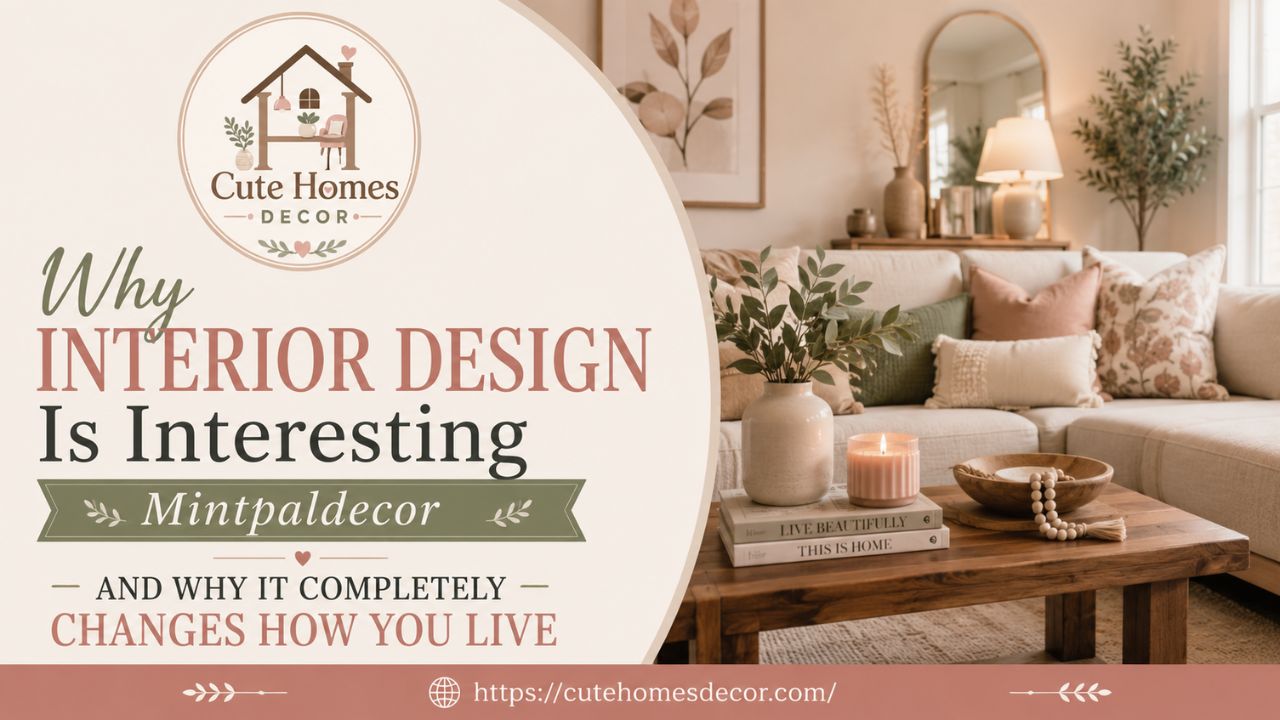

Have you ever walked into a room and felt something shift inside you — a quiet calm, a burst of energy, or that rare sense of being completely at home? That invisible force is interior design, and the reason why interior design is interesting mintpaldecor lovers talk about it endlessly is because it sits at a rare crossroads between art, psychology, science, and personal storytelling. It is not simply about picking curtains or matching cushions. It is about shaping the emotional landscape of every moment you spend indoors.
According to a 2022 study published in the Journal of Environmental Psychology, people spend nearly 90% of their lives inside built environments. That is an extraordinary amount of time — and a compelling reason why understanding and caring about your surroundings is not a luxury but a genuine investment in your wellbeing. Whether you are a first-time renter rearranging a studio apartment or a homeowner planning a full renovation, the principles of good design apply equally to every situation and every budget.
At mintpaldecor home decoration by myinteriorpalace, we believe great design should be accessible, inspiring, and rooted in real life. This article dives deep into what makes interior design endlessly fascinating, explores the latest research behind design choices, and gives you actionable interior design tips to start transforming your space today. Get ready — because once you see how design truly works, you cannot unsee it.

A thoughtfully designed living room — proof that great interior design transforms more than aesthetics; it transforms how you feel.
The Psychology Behind Why Interior Design Is Interesting Mintpaldecor
Interior design is fascinating on the surface — beautiful rooms, clever furniture arrangements, stunning color palettes. But what makes it truly compelling is what happens underneath all of that: the deep psychological relationship between humans and the spaces they inhabit. There is an entire field of study called environmental psychology dedicated to understanding how physical surroundings shape our thoughts, moods, and behaviors.
Research from the Human Spaces Global Report found that workplaces designed with natural elements — plants, natural light, organic materials — boosted employee wellbeing by 15% and creativity by 6%. Translate those findings to your home and the implications are powerful. A thoughtfully arranged bedroom with layered lighting and calming textures does not just look lovely — it measurably improves the quality of your sleep and how you wake up each morning.
Color as an Emotional Language
One of the most immediately impactful and interesting aspects of interior decoration advice mintpaldecor experts share is the deliberate use of color. Color is not decoration — it is communication. Warm terracottas and saffron yellows stimulate conversation and appetite, which is why they feel so right in kitchens and dining rooms. Soft blues and dusty greens lower cortisol levels, creating environments where the nervous system can genuinely relax. Even neutrals carry emotional weight: warm whites feel welcoming while cool grays project sophistication.
Research published by the American Institute of Architects has shown that patients in hospital rooms with access to natural light and calming color palettes required significantly less pain medication. If color can do that in a medical context, imagine the cumulative effect it has on you in the private sanctuary of your home — the place where you recover, recharge, and reconnect with yourself.
Space Planning and the Science of Flow
Beyond color, house decoration advice mintpaldecor professionals always return to the concept of flow — the invisible path your eyes and body naturally follow as you move through a space. Good space planning creates rooms that feel intuitive; you never feel stuck or disoriented. Poor planning, by contrast, makes a room feel chaotic even when it is technically tidy.
The principle of “desire paths” — borrowed from urban planning — applies beautifully to interiors. Furniture should never obstruct the natural routes people take through a room. When traffic patterns are respected, spaces feel larger, more relaxed, and more functional. A sofa positioned away from a wall, creating a defined conversation zone rather than hugging the perimeter, is a classic example of how thoughtful planning changes the entire energy of a living room.
🏡 Interior Design By The Numbers — What Research Tells Us
- 90% of our lives are spent in built indoor environments
- 15% wellbeing boost from nature-inspired interior design
- $150B global interior design market value in 2024
- 72% of homeowners say décor affects their daily mood
- 3× higher resale value linked to well-designed interiors
- 68% of people feel more productive in organized, designed spaces
Interior Decoration Tips That Actually Work in Real Homes
There is a persistent myth that beautiful interiors require massive budgets and professional designers on speed dial. The reality is refreshingly different. Some of the most impactful interior decoration tips mintpaldecor enthusiasts swear by cost almost nothing but a shift in perspective and some focused effort. The secret is understanding the principles that underpin great design — because once you know the rules, you can apply them in any home, at any price point.
The Rule of Three and Grouping Objects
Visual harmony in a room is not accidental. Designers routinely rely on odd-numbered groupings — particularly groups of three — when styling shelves, mantels, and coffee tables. Three objects of varying heights create visual rhythm and interest. Two objects feel static; four can feel cluttered. Try grouping a tall vase, a medium-height candle, and a low decorative bowl on a side table, and notice how the grouping immediately feels considered rather than arbitrary.
This principle extends to larger furniture arrangements as well. Three different textures — say, a linen sofa, a velvet throw, and a jute rug — create layers of tactile interest that make a room feel curated without the need for expensive statement pieces. These are the kinds of interior design tips that transform how a space reads, often within minutes of implementation.
Lighting: The Most Underestimated Element
Ask any experienced interior designer what single change has the biggest impact on a room’s atmosphere and the answer is almost universally the same: lighting. Overhead lighting — the flat, even glow of a central ceiling fixture — is the villain of most home interiors. It is functional but it is merciless, washing out all shadow and depth and making a room feel institutional rather than intimate.
The fix is layering. A well-lit room combines at least three types of light: ambient (general illumination from overhead or recessed sources), task (focused light for reading, cooking, or working), and accent (directed light that highlights artwork, architectural details, or plants). This three-layer approach is foundational house decoration advice mintpaldecor stylists apply to every project regardless of budget.
💡 Pro Decorating Tip
Replace every overhead bulb in your home with a warm-white bulb (2700K–3000K). Then add two floor lamps and two table lamps in your main living area. The transformation will be dramatic — and cost less than a single decorative cushion from a high-end boutique.
Scale and Proportion: The Hidden Architecture of a Room
One of the most common reasons rooms feel “off” — even when they contain objectively beautiful furniture and accessories — is a problem with scale. A delicate loveseat in a double-height loft feels lost. A massive sectional sofa crammed into a small apartment living room feels suffocating. Good house improvement mintpaldecor thinking always starts with respecting the scale of a room.
A practical trick: before purchasing any major furniture piece, tape its footprint on the floor using painter’s tape. Then live with it for a day. You will immediately see whether the proportions work or whether you need to reconsider. This simple step prevents the most expensive decorating mistake — buying furniture that does not fit the room’s geometry.

How to Be Better at Interior Design Mintpaldecor Style
Learning to design well is a skill — and like any skill, it improves dramatically with deliberate practice and the right framework. Understanding how to be better at interior design mintpaldecor devotees have learned is less about innate taste and more about training your eye over time. Here are the building blocks that professional designers spend years internalizing, distilled into actionable guidance for everyday people.
Start with a Mood Board
Before spending a single dollar on anything new for a room, build a mood board. This does not need to be elaborate — a simple Pinterest board, a folder of saved images, or even a collage of magazine clippings works perfectly. The goal is to identify what you are consistently drawn to. Are your saved images warm and organic? Clean and minimal? Eclectic and maximalist? Patterns in your instinctive choices reveal your authentic design sensibility — and that clarity saves enormous time and money later.
The mood board also serves as a filter. When you see a beautiful lamp in a shop, you can check it against your board: does it belong in this visual story you are building, or does it just look nice in isolation? Impulse purchases are the enemy of cohesive interiors; a mood board is your best defense against them.
The 60-30-10 Color Rule
One of the most reliable and widely taught principles in interior decoration advice mintpaldecor design circles is the 60-30-10 rule. It provides a simple formula for creating balanced, harmonious color schemes in any room:
- 60% of the room should be your dominant color — typically walls, large area rugs, or major upholstered pieces. This is your room’s foundation.
- 30% goes to your secondary color — seen in curtains, accent chairs, bedding, or secondary furniture. It provides contrast and visual interest.
- 10% is reserved for your accent color — showcased in throw pillows, artwork, small accessories, and plants. This is where personality lives.
This ratio works because it mirrors how the human eye naturally scans a space — craving a stable backdrop with progressively more specific focal points. Violating it is not impossible, but it requires significant skill to pull off. For most people, trusting the formula yields beautifully balanced results.
Learn to Edit Ruthlessly
Here is something that surprises most beginners: the best interior design tips are often about subtraction, not addition. Restraint is one of the hardest skills to develop because our instinct is always to add more — more color, more texture, more accessories. But professional designers know that a room breathes best when it has room to breathe. Every object should earn its place.
The Japanese concept of ma — negative space — is deeply instructive here. Empty space is not emptiness; it is the pause that makes the music meaningful. A single sculptural object on an otherwise bare shelf creates far more impact than a shelf cluttered with ten charming things competing for attention. Start editing by removing thirty percent of the objects from your most-decorated surface and noticing how the remaining pieces suddenly gain presence and power.
Home Improvement Mintpaldecor: Transforming Spaces on Every Budget
Home improvement mintpaldecor thinking is rooted in the conviction that transformation does not require deep pockets — it requires deep thinking. Some of the most dramatic room makeovers in design history have been achieved with paint, rearranged furniture, and a shift in perspective. Here is a structured approach to improving your home that works across every budget tier.
Quick Wins Under $50
Small changes create outsized results when they target the right elements. These house improvement mintpaldecor-approved upgrades cost almost nothing but deliver remarkable visual impact:
- Swap switch plates and outlet covers for matching brushed brass or matte black versions. These tiny details are everywhere and updating them creates unexpected cohesion.
- Hang curtains at ceiling height, not at window height. This simple switch instantly makes any room feel taller and grander.
- Add a full-length mirror to the smallest room in your home. Mirrors are the most reliable room-expanding tool in any decorator’s kit.
- Group your books by color on shelves. The visual order this creates transforms bookshelves from storage into art.
- Introduce a living plant — even a single pothos or snake plant — to bring organic life and improved air quality to any space.
Mid-Range Upgrades ($50–$500)
With a modest budget, the opportunities expand significantly. Repainting a single accent wall in a deep, rich color is one of the highest-ROI interior decoration tips mintpaldecor readers consistently report. A single gallon of paint costs around $40 and can completely shift the character of a room. A large area rug — perhaps the single most impactful purchase in any living space — pulls furniture together and defines zones in open-plan homes. And replacing tired light fixtures with something characterful (pendant lights, statement table lamps) works the magic of layered lighting mentioned earlier.
Statement Investment Pieces Worth Saving For
Not everything should be bought cheaply. There is a design philosophy called “high-low” styling — mixing investment pieces with affordable finds — that underpins almost every professionally designed interior you have ever admired. The high-investment pieces to prioritize are those you touch every day: the sofa, the bed, the desk chair. These define your physical comfort and the room’s structural bones. Everything else can be sourced cleverly, thrifted thoughtfully, or DIY’d creatively.
“Design is not about how a room looks. It is about how it makes you feel — and how efficiently it supports the life you actually want to live.”

The latest decoration trends in 2025 embrace earthy tones, tactile materials, and biophilic design principles that connect indoors with the natural world.
Latest Decoration Trends Mintpaldecor Is Watching in 2025
Design trends are not arbitrary fashion cycles — the best of them reflect genuine shifts in how people want to live. The latest decoration trends mintpaldecor editors have been tracking for 2025 tell a coherent story: people are turning toward authenticity, sensory richness, and spaces that actively support their mental and physical health. Here are the movements defining interiors right now.
🌿 Biophilic Design🏺 Earthy Terracottas🪵 Japandi Minimalism🧱 Raw Textural Walls💛 Warm Maximalism🔵 Deep Moody Blues♻ Reclaimed Materials🕯 Curved Furniture
Biophilic Design: Nature Moves Indoors
Biophilic design — the integration of natural elements into built environments — is no longer a niche wellness concept; it is the defining design philosophy of the decade. Research from the University of Exeter found that people in environments with plants and natural light reported a 47% increase in creativity and 13% higher productivity. As a response to increasingly urbanized lives, interiors are being reimagined as extensions of the natural world: living walls, indoor trees, natural stone surfaces, rattan furniture, linen fabrics, and unglazed clay vessels are all expressions of this powerful movement.
Warm Maximalism: More, But Make It Intentional
In direct opposition to the clinical minimalism of the previous decade, warm maximalism has arrived with enormous energy. This is not the chaotic clutter of hoarding — it is abundance with intention. Rich layered textiles, gallery walls filled with meaningful objects, stacked books, collections displayed proudly, pattern-on-pattern combinations that somehow cohere into a cohesive whole. The latest decoration trends mintpaldecor tracks show that people are reclaiming personality in their spaces and rejecting the idea that a beautiful home must be a sparse one.
Japandi: The Merger of Two Philosophies
Japandi — the design hybrid of Japanese minimalism and Scandinavian functionality — continues to hold enormous appeal because it solves a real problem: how do you create a space that is simultaneously beautiful, practical, and deeply calming? By combining Japan’s wabi-sabi philosophy (finding beauty in imperfection and natural aging) with Scandinavia’s commitment to craftsmanship and light-filled practicality, Japandi interiors achieve a quiet sophistication that feels genuinely timeless rather than trend-dependent.
The Return of Craftsmanship and Handmade Objects
One of the most meaningful shifts in the latest decoration trends mintpaldecor community embraces is the renewed reverence for handmade, artisan-crafted objects. Mass-produced perfection is giving way to the charming irregularities of hand-thrown pottery, hand-loomed textiles, and hand-carved wooden pieces. These objects carry stories — of the maker’s hands, of natural materials, of time. In a world of algorithmic sameness, they feel radical and deeply personal.
How Mintpaldecor Home Decoration by MyInteriorPalace Approaches Design
The philosophy behind mintpaldecor home decoration by myinteriorpalace is simple but rarely practiced: design that serves the person, not the Pinterest board. Beautiful interiors are ultimately irrelevant if they do not fit the way you actually live. A white linen sofa is aspirational — until you have children or pets or a love of red wine. A minimalist kitchen looks stunning in photographs — until you realize you need to hide evidence of actual cooking.
Real interior design starts with a client’s life before it considers aesthetics. What are your routines? Where do you spend the most time? What activities does each room need to support? What makes you feel at home emotionally, not just visually? These questions — mundane as they might seem — produce the design brief that leads to spaces that are genuinely loved, not just admired. That is what mintpaldecor brings to every project and conversation: a commitment to design that is as functional as it is beautiful.
Practical House Improvement Mintpaldecor Checklist
Whether you are beginning a total renovation or simply refreshing a room, use this checklist to guide the process:
- Audit what you have: Before buying anything new, edit your current space. Remove clutter, reassess furniture placement, and identify what genuinely works.
- Define the function: What does this room need to do? List every activity it should support before making any design decisions.
- Choose your palette: Apply the 60-30-10 rule. Start with your dominant color anchored in something already fixed (flooring, an existing sofa).
- Address lighting first: Layer your lighting — ambient, task, accent — before adding any decorative accessories.
- Layer texture: Introduce at least four different textures (smooth, rough, soft, reflective) to create sensory richness without visual chaos.
- Anchor with rugs: Every seating area needs a rug that is large enough for all furniture legs to sit on or at least touch.
- Add life: Plants, fresh flowers, or even a bowl of seasonal fruit bring organic energy that no manufactured product can replicate.
- Live in it: Give a room two weeks after any major change before deciding anything. Spaces reveal themselves over time.
Ready to Transform Your Home?
Explore curated design guides, room-by-room decorating plans, and expert advice tailored to real homes and real budgets at MyInteriorPalace. Explore MintpalDecor → Start Designing Today
Frequently Asked Questions
Why is interior design interesting to learn about even if you are not a professional?
Understanding why interior design is interesting mintpaldecor advocates point out is that design literacy directly improves your daily life. When you understand the principles of color, light, scale, and proportion, you make better decisions about your home — and those decisions affect your mood, productivity, and sense of wellbeing every single day. It is one of the few skills where learning has an immediately visible and personal impact.
What is the most important interior decoration tip for beginners?
The most universally agreed-upon interior decoration tips mintpaldecor designers share for beginners is: fix your lighting first. Nothing else you do to a room will matter as much as replacing harsh overhead lighting with layered, warm-toned light sources. It is the single change that makes the biggest immediate difference in how a room feels.
How can I improve my home on a very tight budget?
Excellent home improvement mintpaldecor results are absolutely achievable on minimal budgets. Start by rearranging your existing furniture to improve flow. Add thrifted or secondhand pieces for character. Repaint a single accent wall in a bold color. Hang curtains at ceiling height. These zero-to-low-cost moves consistently produce dramatic transformations that feel like a total renovation.
What are the latest decoration trends worth adopting in 2025?
The latest decoration trends mintpaldecor editors recommend for 2025 include biophilic design (incorporating natural materials and plants), warm maximalism (intentional abundance over stark minimalism), Japandi aesthetics (clean lines with natural warmth), and the use of earthy terracotta, warm olive, and deep forest green as dominant color choices. These trends are unified by a turn toward authenticity, natural materials, and spaces that actively support mental wellbeing.
How do I know which interior design style is right for me?
Build a mood board first. Save images of rooms that make you feel genuinely happy — not rooms you admire intellectually but rooms that make you want to step inside. After collecting 30 to 50 images, patterns will emerge: dominant colors, recurring materials, levels of layering, and moods. Those patterns are your authentic design sensibility. Let them guide every decision from there.
What does house decoration advice mintpaldecor give for small spaces?
For small spaces, house decoration advice mintpaldecor professionals prioritize four things: vertical storage to draw the eye upward, mirrors to multiply light and visual space, multi-functional furniture (ottomans with storage, sofa beds, expandable dining tables), and a cohesive color palette that flows from room to room without interruption. Keeping the floor as clear as possible is equally crucial — visible floor space is what the brain reads as “room.”
Is it worth hiring a professional interior designer?
For significant renovations or when you feel consistently stuck in a space, professional interior design tips and guidance from a designer can save money in the long run by preventing costly mistakes. Many designers now offer hourly consultations or online design services that make professional advice accessible at lower price points. For smaller decorating projects, learning the fundamentals yourself — as outlined in this guide — produces excellent results without the professional fee.
How does interior design affect mental health?
The research is robust and consistent: your physical environment profoundly affects your psychological state. Cluttered spaces elevate cortisol (the stress hormone). Rooms with access to natural light improve sleep quality, mood, and alertness. Color choices influence emotional regulation. Spaces that are organized but personalized — combining order with self-expression — consistently score highest in wellbeing studies. Good house improvement mintpaldecor is, at its core, an act of self-care.
What is the best way to follow current interior design trends without dating my home?
The golden rule is to invest in timeless bones and play with trends through accessories and paint. A classic linen sofa, quality hardwood floors, and simple architectural details will outlast any trend cycle. Then express the latest decoration trends mintpaldecor tracks through easily changeable elements: throw pillows, rugs, artwork, plants, and accent colors in accessories. This approach keeps your home feeling current without requiring a full redesign every few years.
Conclusion
Interior design is interesting precisely because it is never just about design. It is about the quality of your daily life, the stories your spaces tell, the comfort they provide during difficult times, and the joy they add to ordinary moments. Understanding why interior design is interesting mintpaldecor is really understanding why the places you inhabit matter deeply — and why investing attention and intention in them is always worthwhile.
Whether you start by swapping a light bulb, rearranging a bookshelf, or finally committing to that accent wall you have been dreaming about for months, the most important step is simply to begin. Design is a practice, not a destination — and every small improvement compounds into a home that genuinely reflects and supports who you are.
At mintpaldecor home decoration by myinteriorpalace, our mission is to make great design thinking accessible, joyful, and deeply practical. We hope this guide has given you not just inspiration, but the frameworks and confidence to make real, lasting changes to your space. Your home deserves it. And so do you.
Ready to go deeper? Explore more guides, room transformations, and curated product advice at MyInteriorPalace / MintpalDecor — where every home has a story worth designing.