
Stop the flooding, protect your foundation, and reclaim your outdoor space — without breaking the bank.
Water is patient. It will find every crack, every low spot, every weakness in your yard — and it will sit there, quietly ruining everything from your lawn to your home’s foundation, until you do something about it.
If you’ve ever walked out after a rainstorm to find a swamp where your backyard used to be, you already know the frustration. The good news? There are powerful, proven yard drainage solutions for almost every type of property — whether you’re dealing with a flat lawn that pools, a steep hillside that sheets water, or a backyard that floods every time the clouds open up. You don’t always need to hire a contractor. Many of the best fixes are genuinely DIY-friendly, and this guide is going to walk you through all of them.
Landscape drainage isn’t just about comfort — it’s about protecting one of your biggest investments. Standing water destroys grass, breeds mosquitoes, erodes soil, and — most critically — creates drainage around house foundation problems that can cost tens of thousands of dollars to repair. Whether you’re exploring lawn drainage solutions, planning a full yard drainage system, or just looking for quick backyard drainage ideas, this is the guide you’ve been searching for.
Let’s dig in — literally.
Why Poor Drainage Destroys More Than Just Your Lawn
Before jumping into fixes, it helps to understand exactly what poor drainage is doing to your property. Most homeowners think of standing water as a cosmetic problem, but the damage runs much deeper than dead grass.
When water drainage is inadequate, water saturates the soil around your home’s foundation. Over time, this pressure causes cracking, bowing, and settling — structural issues that are enormously expensive to reverse. Beyond the foundation, drainage problems and solutions become urgent when you notice: soggy patches that never fully dry, moss and fungal growth, erosion channels cutting through garden beds, or water seeping into a basement.
Understanding what is a drainage system helps frame the problem. Simply put, a drainage system is any arrangement of channels, pipes, grading, or structures designed to move excess water away from an area. Residential properties rely on a combination of surface drainage solutions and underground systems. When either fails, problems cascade.
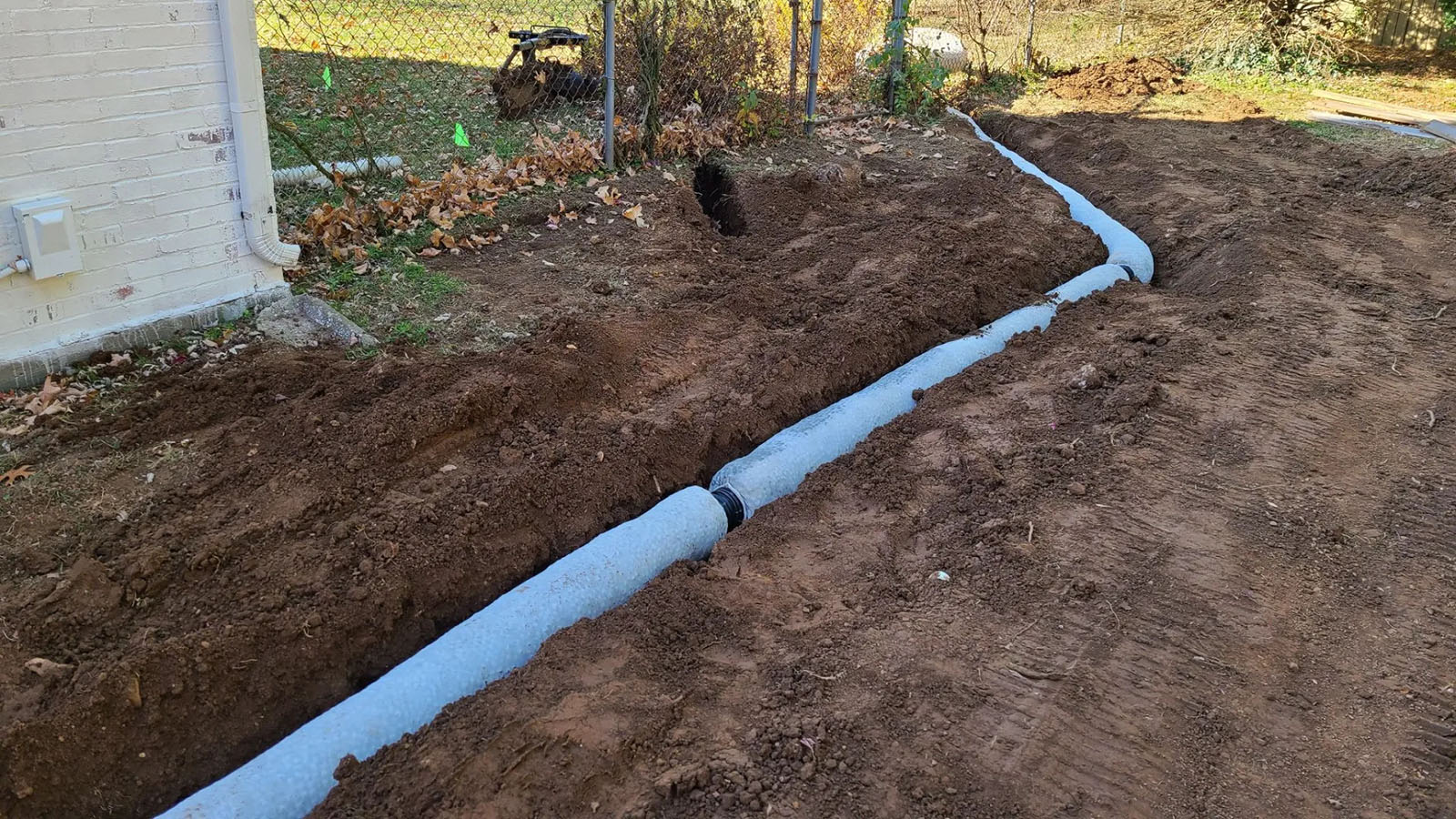
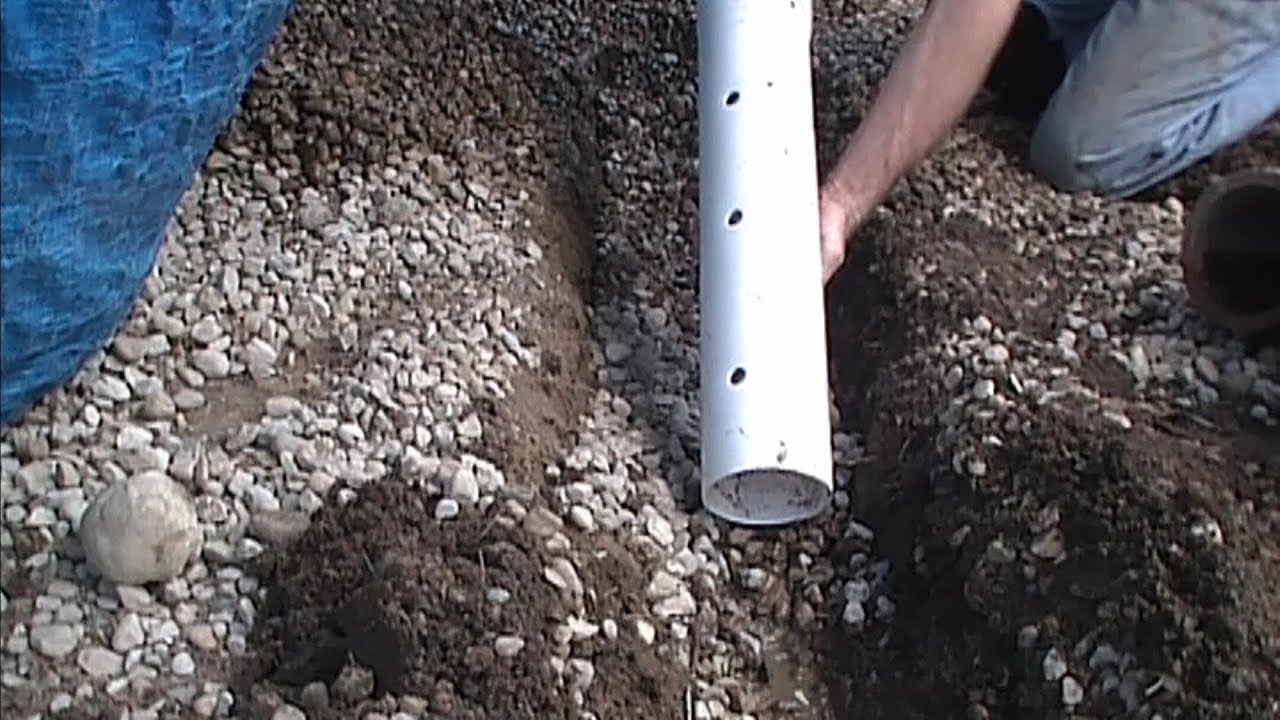
A properly installed French drain — one of the most effective yard drainage solutions for managing both surface and subsurface water around your home.
Signs You Need Drainage Correction Right Now
Recognizing the warning signs of drainage correction needs early can save you a fortune:
- Water pools in the same spots after every rain — a classic sign of water drainage in yard failure
- Your lawn stays mushy for days after rainfall, indicating lawn drainage issues
- You have visible erosion channels or ruts in garden beds
- Efflorescence (white salt deposits) forming on your foundation walls
- Water consistently flows toward the house rather than away from it
- Basement dampness or musty smells after rain events
[!] Don’t Ignore Foundation Risk: Water pooling within six feet of your home’s foundation is a serious warning sign. Proper drainage around house isn’t optional — it’s one of the most important things you can do for your home’s long-term structural health.
Understanding the Types of Yard Drains and Drainage Systems
There is no single “best” drainage solution — the right fix depends entirely on your property’s layout, soil type, the source of the water, and your budget. Understanding the types of drainage systems for yards gives you a vocabulary for solving the problem intelligently.
French Drains — The Workhorse of Residential Drainage
If you’ve done any research into drainage solutions for yard problems, you’ve probably already heard of the French drain. Despite the name, it was popularized by Henry French, a 19th-century Massachusetts farmer who wrote about it in an agricultural guide.
A DIY French drain consists of a gravel-filled trench containing a perforated pipe. Water seeps through the gravel, enters the pipe, and is directed downhill and away from problem areas. It’s effective for both surface and subsurface water, making it one of the most versatile French drain solutions available. French drain ideas range from simple straight runs to elaborate networks that address multiple problem zones simultaneously.
For homeowners dealing with backyard flooding solutions, a diy french drain around house can be a game-changer. You can install a trench drain around house to intercept water before it reaches the foundation. Costs for materials on a diy drainage project typically run $5–15 per linear foot depending on depth, pipe size, and gravel type.
Channel Drains and Trench Drains
A diy channel drain or diy trench drain is a linear surface drain ideal for driveways, patios, and walkways. Unlike a French drain, a channel drain sits flush with (or slightly below) a hard surface to intercept water running across it. Driveway drainage ideas almost always involve some form of channel or trench drain at the base of a slope.
A homemade channel drain can be built with pre-formed concrete or plastic channel sections. These are excellent patio drainage options and work well as part of a broader patio drainage system. For homeowners looking at sidewalk drainage solutions, a channel drain embedded across the path can stop water from sheeting toward the foundation.
Surface Drains and Area Drains
Surface drains for yard use catch basins — grated inlets that collect water pooling on the surface and route it through underground pipe to a discharge point. They work well in flat areas where flat yard drainage solutions are needed. A single yard drain placed in a low spot can eliminate chronic ponding entirely.
Area drains landscape applications also include channel systems along fence lines — a common need when neighbors’ properties shed water onto yours, requiring drainage fence line solutions.
Swales — Nature’s Own Drainage System
A swale is a shallow, gently sloped channel, typically planted with grass or low groundcover, designed to slow and redirect surface water. It’s one of the most attractive and cost-effective drainage landscaping approaches available. Correct yard drainage with swale methods are popular because they work with the landscape rather than cutting through it.
Swales are particularly well-suited as slope drainage solutions and hillside drainage solutions because they intercept water partway down a slope. They double as drainage ditch ideas that actually enhance curb appeal rather than detracting from it.
QUICK COMPARISON: TYPES OF RESIDENTIAL DRAINAGE SYSTEMS
| System Type | Best For | Key Benefit |
| French Drain | Subsurface waterlogging, foundation drainage | Handles both groundwater and surface seepage |
| Swale / Ditch | Slopes, large surface runoff, natural look | Low-cost, attractive, ecologically friendly |
| Channel Drain | Driveways, patios, hardscaped areas | Handles fast-moving surface runoff cleanly |
| Catch Basin | Flat yards, persistent low spots | Reliable, low-maintenance surface collection |
| Rain Garden | Eco-friendly runoff management | Improves soil permeability over time |
| Dry Well / Pit | Concentrated discharge, downspout overflow | Gives water a place to percolate slowly |
DIY Yard Drainage Solutions You Can Do Yourself This Weekend
The prospect of yard drainage solutions do yourself projects can feel daunting, but many are more approachable than you’d think. If you’re comfortable with a shovel, a level, and a bit of planning, a large number of diy yard drainage projects are genuinely within reach.
How to Install a French Drain (Step-by-Step)
This is the foundational diy backyard drainage system project and one that can transform a perpetually wet yard. Here is how to do diy drainage for yard with a French drain:
- Plan your route. Identify the wet area and trace a path downhill to a safe discharge point. Mark the trench line with spray paint or string.
- Dig the trench. Excavate 12–18 inches deep and 12 inches wide, maintaining a consistent downhill slope of at least 1% (1 inch per 10 feet). This is critical for diy drainage for yard performance.
- Line with filter fabric. Lay landscape filter fabric in the trench, overlapping the sides. This keeps soil out of your gravel — one of the most overlooked steps in diy drainage solutions.
- Add gravel base. Pour 2–3 inches of 3/4-inch clean crushed stone. Pea gravel yard drainage solutions do yourself or river rock yard drainage solutions do yourself can also be used.
- Lay perforated pipe. Set the pipe holes-down on the gravel bed.
- Cover with more gravel. Fill to about 3 inches below grade.
- Wrap the fabric. Fold the filter fabric over the top of the gravel and secure.
- Backfill. Top with topsoil and sod or seed. Your DIY French drain is complete.
How to Grade a Yard for Drainage
How to grade a yard for drainage is often the most fundamental fix. The standard recommendation is that the ground should slope away from your home’s foundation at a minimum rate of 6 inches over the first 10 feet.
For how to grade a yard for proper drainage, you’ll need topsoil, a landscaping rake, a long straight board, and a level. Add soil to low areas, shape toward a natural outflow point, and compact lightly. This alone resolves a surprising number of drainage problems and solutions without any pipe or gravel at all.
Building a Drainage Ditch or Swale
If you’re dealing with significant runoff, building a drainage ditch or how to make a drainage ditch by hand is highly achievable. A well-designed drain ditch is essentially a shallow swale with defined sides, often lined with rock or planted with groundcover to resist erosion.
For aesthetics, consider how to make a ditch look good by lining it with attractive round river rock, installing native plantings on the banks, or shaping it into a gentle naturalistic curve. Rock garden drainage designs can make a functional drainage channel into a genuine landscape feature.
How to build a rock drainage ditch: dig a trench 12–18 inches wide and 8–10 inches deep along the desired flow path. Line with filter fabric, fill with 4–6 inches of river rock or cobble, and leave the top exposed. Water flows through the rock rather than over it, dramatically improving rainwater drainage performance.
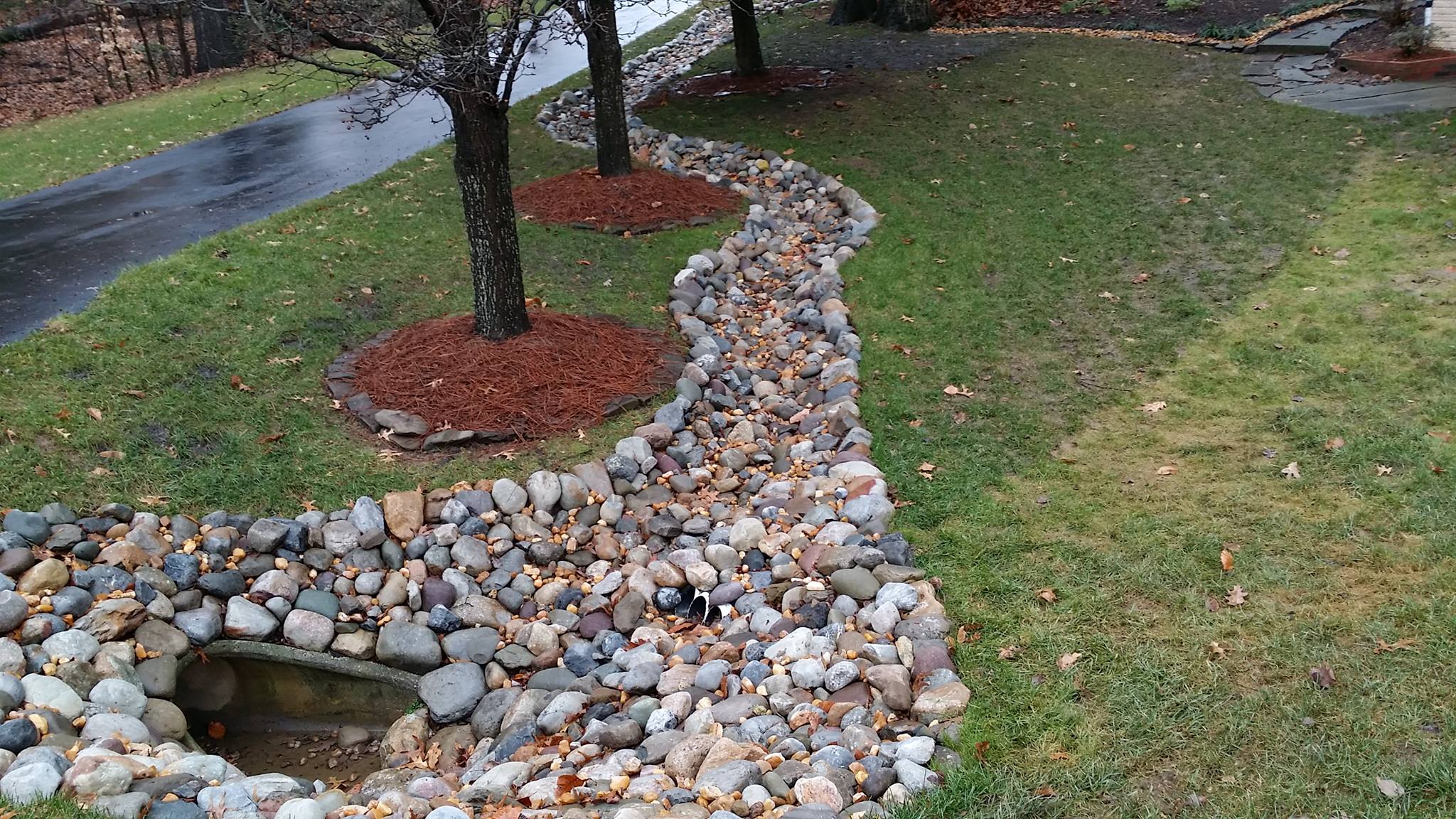

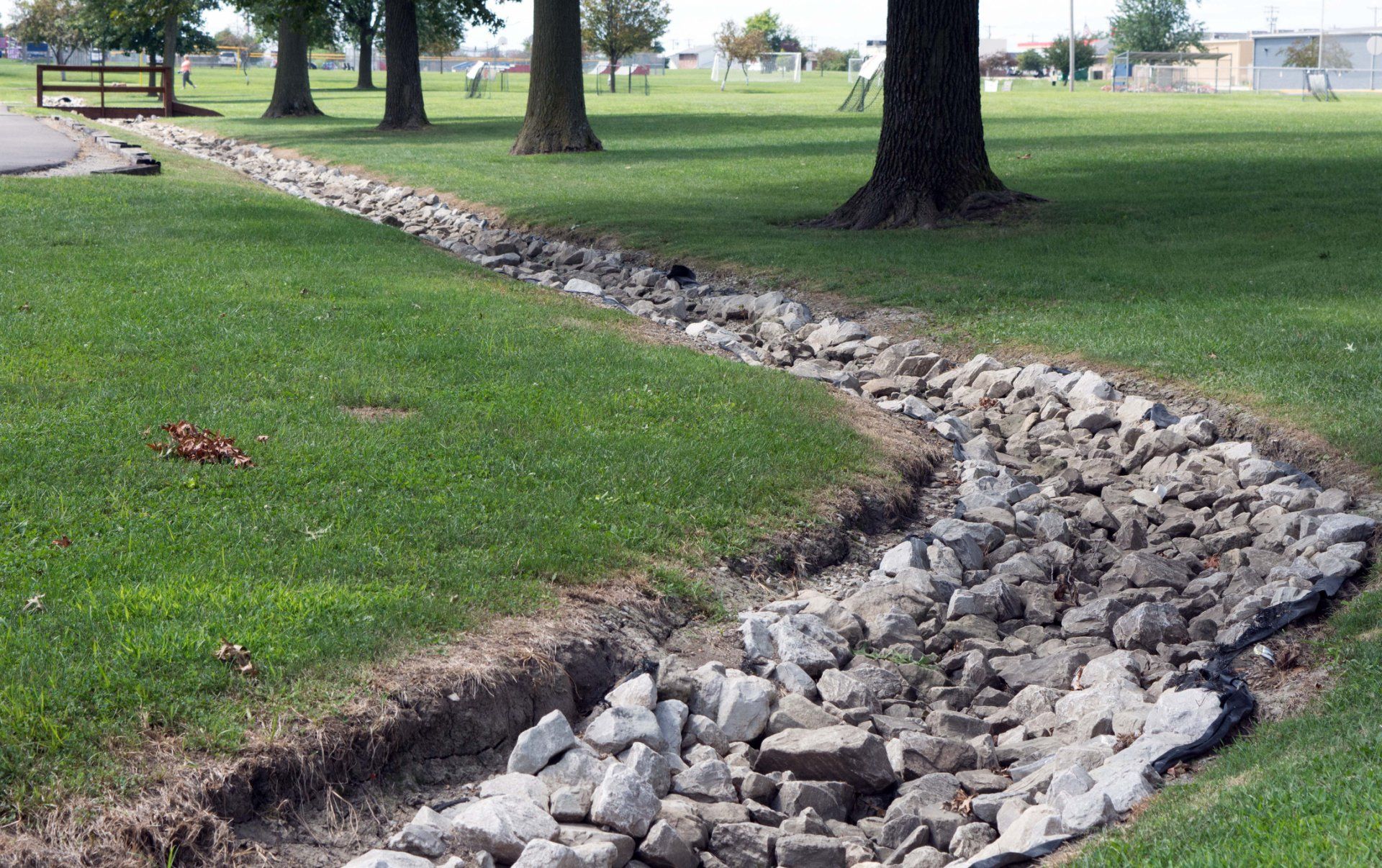
A river rock-lined drainage swale blends naturally into the landscape while channeling rainwater away from the yard and foundation efficiently — a perfect DIY backyard drainage solution.
DIY Dry Well for Backyard Flooding
A drainage pit in yard or dry well is a simple, effective solution for concentrated water. How to build a drainage pit: dig a hole approximately 3 feet wide and 4 feet deep. Line with filter fabric, fill with large coarse gravel, fold the fabric over the top, and backfill. Connect an inlet pipe from the problem area.
Dry wells work by giving water a concentrated place to percolate slowly into the soil. They’re one of the cheapest and most reliable backyard drainage solutions for homeowners whose soil has at least moderate permeability.
DIY Driveway and Patio Drainage
Diy driveway drainage typically involves installing a trench drain at the base of the driveway. For patio drainage solutions, a channel drain around the perimeter of a patio prevents water from pooling against the house or running off in uncontrolled sheets.
Landscaping for Drainage — Design Meets Function
Some of the most effective drainage solutions for yards are actually landscape design decisions. Landscaping for drainage means choosing plants, hardscape materials, and topographic shapes that actively help manage water rather than fighting it with pipes alone.
Rain Gardens — Beautiful and Functional
A rain garden is a shallow, planted depression designed to capture and absorb storm runoff. It’s one of the most elegant garden drainage solutions available. Garden drainage ideas using rain gardens involve native plants with deep root systems that improve soil permeability over time.
For placement, position the rain garden at least 10 feet from the foundation, in a naturally low area or at the end of a swale. The garden drainage system maintains itself once established, providing ongoing improvement to water drainage landscaping across the entire property.
Landscaping to Divert Water — Strategic Planting and Grading
Landscaping to divert water doesn’t have to mean heavy construction. Strategically placed berms can redirect rain drainage around sensitive areas. A berm placed uphill from a structure acts as a water interceptor, channeling flow around the building before it can concentrate near the foundation.
Landscaping for water runoff also considers impervious surface ratios. Permeable pavers, gravel paths, and grass pavers are excellent landscaping drainage ideas that reduce runoff at the source rather than requiring collection infrastructure downstream.
Drainage Landscaping for Sloped Properties
Diy sloped yard drainage is one of the more challenging scenarios because gravity is both the problem and the tool. Landscaping sloped yard drainage typically involves a combination of terracing, swales, and French drains.
Hillside drainage problems are particularly acute because water builds velocity as it descends. Slope drainage solutions like riprap channels, terraced planting beds with retaining walls, and deep-rooted native plants all help slow water and prevent damage. Drainage for sloped yards may require a hillside drainage system incorporating perforated pipe running horizontally across the slope to intercept subsurface flow.
Pro Tip — Landscaping for Water Drainage: Before investing in any system, spend 30 minutes in your yard during a heavy rain. Watch where water flows, where it pools, and where it’s coming from. This observation is worth more than any survey — it shows you exactly where to focus your landscape drainage efforts.
Drainage Around the House — Protecting Your Foundation
No area of your property is more critical for drainage than the zone immediately around your home. Water drainage around house management determines whether your foundation stays dry and stable for decades, or begins showing stress within a few years.
How to Drain Water Away From House
How to drain water away from house comes down to three principles: grade, gutters, and drain paths. First, ensure the drainage away from house grade is correct. Second, make sure your gutters and downspouts are directing water at least 6–10 feet from the foundation. Third, create a clear path for that water to travel via a swale, drain system around house, or piped outlet.
Ideas to drain water away from house that are particularly effective include extending downspout extensions, installing a french drain backyard flooding perimeter system, improving grading with topsoil, and ensuring that any drainage trench around house flows toward a proper outlet.
Installing Drainage Around the House Foundation
How to install drainage around house for foundation protection typically involves a combination of exterior grading and a perimeter drain tile system. A drain around house collects water at the footing level and routes it to a sump pit or daylight outlet. This is the most robust form of exterior drainage solutions and is often the foundation of a full residential drainage system.
For less severe situations, improving proper drainage around house can be as simple as installing window well covers, extending downspouts, and adding topsoil to areas where the grade has settled toward the foundation. These low-cost home drainage solutions can dramatically reduce moisture intrusion without excavation.
Above Ground Drainage Solutions
Above ground drainage solutions like surface channel drains, decorative rock channels, and downspout diverters are fast, relatively cheap, and reversible. Temporary drainage solutions such as sandbag berms, pump-out systems, and surface channel redirects can buy time while you plan a permanent fix.
Rain water diversion methods at the above-ground level include downspout splash blocks, corrugated flexible pipe extensions, and decorative river rock “rivers” that double as attractive water run off drain paths from downspouts across the yard.
Specific Drainage Scenarios — Solutions for Every Property
Front Yard Drainage Solutions
Front yard drainage solutions are complicated by the need to maintain curb appeal. A front yard drainage ditch ideas approach using planted swales, decorative rock channels, or permeable paving keeps the yard looking polished while solving the drain in front of house problem. A front yard drainage ditch disguised with native plants and river rock can be almost invisible while doing serious drainage work.
Side Yard Drainage Solutions
Side yard drainage solutions are critical because side yards are often narrow, shaded, and sloped toward the foundation. A French drain or channel drain running the length of the side yard is typically the most effective fix. Drainage side of house problems often arise when neighboring properties shed water onto yours — a drainage between houses berm or French drain can intercept that water at the property line.
Backyard Drainage Solutions for Flat Lots
For homeowners with flat properties, backyard water drainage solutions require creating artificial grade where none exists. Wet backyard solutions for flat lots also include improving soil permeability through aeration and organic matter — a surprisingly effective long-term strategy.
Patio and Driveway Drainage Ideas
Patio drainage ideas should be part of the patio design from day one. A patio that slopes even 1/8 inch per foot away from the house ensures water runs off cleanly. Patio drainage options include channel drains along edges, drain grates set in the patio surface, and permeable paving systems. Driveway drain ideas similarly focus on channel drains at the base or across the middle of the driveway.


Channel and trench drain systems offer clean, effective patio and driveway drainage solutions — intercepting surface runoff before it reaches the home’s foundation.
Garden Drainage for Raised Beds and Flower Gardens
Poor garden drainage kills plants just as surely as drought. Flower bed drainage solutions typically involve improving the soil mix with coarse sand and organic matter, installing a flower bed drainage pipe below the bed, or raising the bed above the surrounding grade. Garden drainage pipe systems can be connected to the main property drainage network or discharged to a lower area of the garden.
Choosing Drainage Materials — What Works Best
Not all drainage materials are equal. The choices you make in gravel type, pipe material, and fabric quality will determine how well and how long your system performs.
Pipe Types and Sizes
For most residential applications, 4-inch perforated PVC or corrugated polyethylene pipe is standard for French drains and underground collection systems. Corrugated pipe is cheaper and more flexible; PVC is more rigid and durable, better for long straight runs.
Gravel and Rock
3/4-inch washed crushed stone is the most commonly used gravel for French drains and dry wells because it offers large void space for water storage and flow. River rock yard drainage solutions do yourself projects often use rounded river rock for aesthetic channels. Pea gravel yard drainage solutions do yourself approaches use pea gravel where finer material is acceptable.
Filter Fabric
Non-woven geotextile fabric is essential for preventing soil migration into gravel. Skipping it is one of the most common DIY mistakes — within a few years, the gravel voids fill with fine soil particles and the drain stops working. Use fabric on all buried drain systems.
Drainage Pipe in Yard — Depth and Placement
A drainage pipe in yard should typically be buried a minimum of 12–18 inches deep. For gravity systems, maintain a 1% minimum slope throughout. Underground yard drainage networks should include cleanout access points every 50–100 feet for maintenance.
Professional vs. DIY — When to Call a Drainage Expert
While an enormous range of diy drainage system projects are accessible to motivated homeowners, some situations genuinely call for professional help. Knowing the difference saves money — and avoids expensive mistakes.
| Situation | DIY or Pro? | Why |
| Simple French drain for lawn pooling | DIY [DIY] | Straightforward, tools are basic, low risk |
| Regrading small yard areas | DIY [DIY] | Topsoil + rake + level is achievable for most |
| Foundation perimeter drain tile | Pro [Pro] | Requires excavation near foundation; errors are costly |
| Complex multi-zone yard drainage design | Pro [Pro] | Needs proper landscape drainage plan and engineering |
| Connecting to municipal stormwater system | Pro [Pro] | Requires permits, inspections, licensed contractor |
| Downspout extensions + splash blocks | DIY [DIY] | Quickest and easiest easy drainage solutions |
| Installing yard catch basins | DIY [DIY] | Moderate skill level, kits available at home stores |
For complex situations like a hillside drainage system, extensive residential drainage design, or problems that have already caused foundation damage, investing in a professional residential drainage assessment is well worth it. A good drainage contractor will produce a landscape drainage plan that integrates all the yard drainage systems components into a coherent solution rather than addressing symptoms piecemeal.
Frequently Asked Questions About Yard Drainage Solutions
What is the most cost-effective yard drainage solution for a homeowner on a budget?
For most homeowners, regrading the yard and extending downspouts are the cheapest first steps — often under $200 in materials. If those don’t solve the problem, a diy french drain is typically the next most cost-effective option, running $5–15 per linear foot in materials. Cheap drainage solutions almost always start with addressing grade and downspout routing before moving to pipe systems.
How do I drain water away from my house foundation without breaking the bank?
How to drain water away from foundation affordably: start with proper grading (ensure the soil slopes away from the home), extend downspouts at least 6–10 feet, and add splash blocks or flexible pipe extensions. If water still collects near the foundation, a simple interceptor French drain 2–3 feet from the house wall is usually sufficient.
What is the difference between a French drain and a trench drain?
A DIY French drain is a gravel-filled trench with a perforated pipe that captures subsurface water seeping through the soil. A diy trench drain (or channel drain) is a surface-level linear drain with a grated top that captures water running across a hard surface. French drains handle groundwater; trench drains handle surface runoff. Many comprehensive yard drainage systems use both in combination.
How can I improve drainage in a flat yard with no natural slope?
Flat yard drainage solutions require creating artificial grade or providing underground collection points. Options include catch basins connected to underground pipe, building raised beds and berms to create topographic variation, or installing a sump pump system. How to improve drainage in yard on a flat lot often requires more planning than sloped properties, but is entirely solvable.
What are the best DIY drainage solutions for a sloped yard?
Diy sloped yard drainage typically involves a combination of: a swale or drainage ditch to intercept and redirect water across the slope; terracing with retaining walls to reduce slope length and velocity; and a French drain at the base of the slope to capture what soaks in. Drainage for sloped yards succeeds when you work with gravity rather than against it.
How do I fix drainage in my backyard that floods every time it rains?
How to fix drainage in yard that floods regularly starts with identifying the water source — is it coming from uphill neighbors, overflowing gutters, or just accumulating in a low spot? For diy backyard flooding solutions, a combination of improving grade, installing a catch basin, and routing water through underground pipe to a suitable outlet is usually the most reliable approach.
Can landscaping really help with drainage, or do I need pipes?
Absolutely — landscaping for drainage can be surprisingly effective on its own for moderate problems. Deep-rooted native plants dramatically increase soil permeability over time. Strategic berms and swales redirect and slow water. Rain gardens absorb and filter runoff. For mild poor drainage situations, thoughtful drainage landscaping may eliminate the need for any pipe work at all.
How deep should a yard drain be installed?
For a standard French drain or drain in yard installation, the bottom of the trench should be at least 18–24 inches below grade. In cold climates, place the pipe below the frost depth to prevent heaving. Always call 811 (in the US) before digging to have underground utilities marked.
What’s the best way to drain standing water from my yard quickly?
To drain yard standing water quickly: use a submersible pump to remove the immediate standing water, then identify and address the root cause. For ongoing wet yard drainage solutions, installing a catch basin connected to a discharge pipe provides a permanent solution.
Conclusion — Taking Control of Your Yard’s Water Problem
Living with a poorly draining yard is one of those slow-motion problems that tends to feel manageable right up until it isn’t anymore — until the foundation cracks, the basement floods, or the lawn simply refuses to recover. The good news is that virtually every yard drainage challenge has a solution, and many of the most effective ones are well within DIY reach.
Whether you choose a simple grading correction, a diy french drain, a channel drain for the driveway, a planted swale, or a full residential drainage system designed by a professional, the key is to start. Observe where water moves on your property, identify the source, and match the drainage solution to the actual problem rather than applying a generic fix. Landscaping water drainage done well becomes invisible — a seamlessly managed system that protects your home and your investment season after season.
The strategies in this guide — from diy drainage solutions to professional landscape drainage systems — give you a complete toolkit. Take the time to plan carefully, use the right materials, and maintain your system once installed. Your yard, your foundation, and your peace of mind will thank you for it.